domenica 19 febbraio 2017

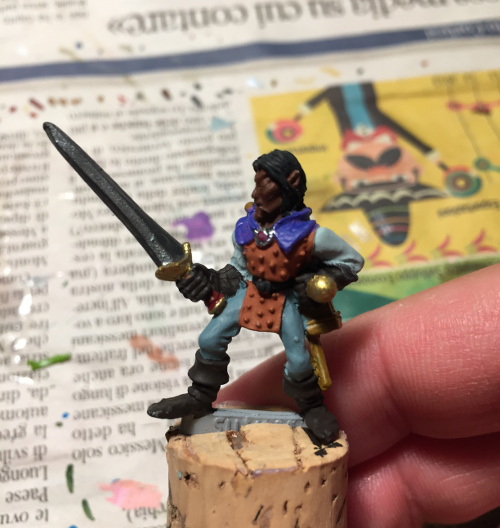
My first miniature - Metal Magic Elf Archer w Cape


It was sometimes between 1993 and 1995, I guess. There was this shop, Pergioco, on the back of piazza Cordusio in Milan. It looked like a tiny shop, but there was a stair leading downwards into a very large room packed with boardgames, role-playing games, miniatures, dice and such. It was Saturday afternoon paradise, for an early teenager like I was.

Not that I had the money to buy anything. The subway tickets to the city centre took away about 40% of my weekly budget. But still, a few months after playing my first session of RPGs, I decided to buy a miniature. It was though deciding which one, but finally the choice fell on this one.

Elf Archers with Cape (1033e, 1992) from Metal Magic, a brand at that time owned by Hobby Products, a German manufacturer. To this day, I consider this one of the finest miniatures ever produced, and one that has shaped my aesthetic taste in fantasy. Truly, Josef Ochmann did a hell of a job on this one.


Take the perfect dynamic pose, for example: this Elf is loading an arrow and is set to shoot at a distant point, aiming slightly upwards to achieve a longer range. He has a distinctive elfin physique, slim but proportionate. Then there are the details: the trimming on the tunic, the fishlike scales of the armour following the shape of the chest, giving the idea of a lightweight armour and not a heavy one falling vertically. The sword on one side and the quiver on the other. High boots and a long cape. This is the hyperuranic elvish adventurer.

This was, for a long time, Haldir, the Sinda warrior from the Grey Havens, whom I played in MERP. Too bad I had no idea how to paint it and no budget to buy the expensive sets for painting at the time.

So I gave it to one of the guys in my playing group, because he claimed he was good. He held it for about 6 months and, after repeated requests to return it, gave it back with the lousiest paintjob ever. It was, quite literally, a clumsy brush of pink on the face and hands, one of grey on the armour, and one of green on the cloak. End of it (WIP, he claimed). But what made me really mad was that I made ONE request: that the cape was to grey. Haldir was a Grey Elf, after all, and having read the Silmarillion quite recently, I was adamant about it.

Years later I found another friend (I had left the old group since, and wasn't playing MERP anymore) who could paint, and graciously offered to paint my miniature. He did what you see now, a very nice paintjob, at least for a teenager from the 90s. We didn't have much money fro colours and brushes, and we didn't have any access to GW's paint courses or youtube tutorials. Everything was perfect, except for one detail: the cape was, again, green.

If you want a job well done, they say, there's only one way to do it. So I did it myself. Meanwhile the GW shop had opened in Milan, I got myself a set of colours, and painted the cloak in grey. And that's how, over the course of several year, this miniature got painted.

What was your first miniature? Any interesting story to share? Let me know in the comments!


domenica 15 gennaio 2017

Berengar Took - Mithril Hobbit Scout on Pony (M60)

It's funny how you start painting a miniature with no idea or inspiration, and you end up with a piece that's not only above your average, but also developed in your hands, way beyond your original intention, and actually came to represent a character with an appealing background story.
 

That's what happened with Mithril Hobbit Scout on Pony (M60), which I started painting in October 2016, and finished in the last days of the year. During its painting I put it down and picked it up again a number of times, choosing to focus some days on other miniatures that were, at the time, more interesting.

The only ideas I had, when I started, was that the hobbit should have dark brown hair and a green cloak. In the end it had a green cloak, indeed. The hair somehow started with a light brown and came up almost blonde.


A blonde hobbit? Why not? Before repainting my mistake, I did some research, and came up with a quote.
Before the crossing of the mountains the Hobbits had already become divided into three somewhat different breeds: Harfoots, Stoors, and Fallohides. The Harfoots were browner of skin, smaller, and shorter, and they were beardless and bootless; their hands and feet were neat and nimble; and they preferred highlands and hillsides. The Stoors were broader, heavier in build; their feet and hands were larger, and they preferred flat lands and riversides. The Fallohides were fairer of skin and also of hair, and they were taller and slimmer than the others; they were lovers of trees and of woodlands.
FotR
Well, Mithril said it's a scout, so... Fallohide it is. Fair-skinned and fair-haired, our hobbit needs a name now.
In some old families, especially those of Fallohide origin such as the Tooks and the Bolgers, it was, however, the custom to give high-sounding first-names. Since most of these seem to have been drawn from legends of the past, of Men as well as of Hobbits, and many while now meaningless to Hobbits closely resembled the names of Men in the Vale of Anduin, or in Dale, or in the Mark, I have turned them into those old names, largely of Frankish and Gothic origin, that are still used by us or are met in our histories. I have thus at any rate preserved the often comic contrast between the first-names and surnames, of which the Hobbits themselves were well aware.
RotK, Appendix F
Took. Everything seems to fall into place, now! I think I'll call him Berengar, just because I'm a big fan of Berengar I of Friuli, king of Italy (888-924) and son of Eberhard the Saint, one of the closest advisors to emperor Louis the Pious.

Berengar Took. The Scout. Or, even better, the Adventurer!
[...] certainly there was still something not entirely hobbit-like about them, - and once in a while members of the Took-clan would go and have adventures. They discreetly disappeared, and the family hushed it up; but the fact remained that the Tooks were not as respectable as the Bagginses, though they were undoubtedly richer.
Hob
I can almost hear Berengar's mum, complaining that all the family loved trees and woodlands, but it was certainly not normal for one of them to go and visit the great forests beyond the Brandywine! 
"Where did all that talk of elves and dragons, and magic rings and shining swords came from?" wondered Berengar's mother.
"I tell you where it came from" muttered his Uncle, Ludovic, while sucking on his pipe "from that ol' Wizard that comes every now and then. He looks all jolly and friendly, but he's up to no good, mark my words!"
"The Wizard?!?" gasped the woman.
Not the fellow who used to tell such wonderful tales at parties, about dragons and goblins and giants and the rescue of princesses and the unexpected luck of widows' sons? [...] Not the Gandalf who was responsible for so many quiet lads and lasses going off into the Blue for mad adventures. Anything from climbing trees to visiting Elves - or sailing in ships, sailing to other shores! 
Hob
Yep, that one.

That Gandalf better stay away from my children!
Anyway. The miniature is lovely, really. One of the best I've seen so far from Mr. Tubb. The date on the base is 1988 and the sculpt belongs to the group "Gandalf and the Shire-folk".


What I really like about this miniature is that it manages to be full of realistic detail and, at the same time, have something magical and poetic.


The drapery of the cloak is just perfect. And the way the hobbit looks around - perhaps scanning the landscape, perhaps marvelling at it - is just glorious. Also the pony is finely sculpted, with the right proportions and a strolling pose matching the relaxed position of the rider. 


The baggage is very well done, and so is the short sword hanging from the side.


And did I mention the drapery of the cloak, yet? No, this is probably one of my favourite Mithril miniatures so far. Ride, Berengar, follow the Road to wherever it goes!
           Farewell we call to hearth and hall!
           Though wind may blow and rain may fall,
           We must away ere break of day
           Far over wood and mountain tall.

           To Rivendell, where Elves yet dwell
           In glades beneath the misty fell,
           Through moor and waste we ride in haste,
           And whither then we cannot tell.

           With foes ahead, behind us dread,
           Beneath the sky shall be our bed,
           Until at last our toil be passed,
           Our journey done, our errand sped.

           We must away! We must away!
           We ride before the break of day!


venerdì 6 gennaio 2017

Lamshâr - Citadel Silvan Elf ME31 (1985)

I got on eBay this cool Jess Goodwin sculpt from 1985, which was sold by Citadel as Silvan Elf ME31. Interestingly, the same figure was later included in the 1989 Citadel Late Summer Catalogue (item 074213/2) as Wood Elf Champion. I bought it without a clear idea of what to do with it and then, on a whim, last month I decided to paint like one of the main NPCs, and by far one of the best villains, of my WFRP campaign.
The miniature was missing the original shield and I had to make do with a different one - full shield, to which I added a hole with a hot screw, and by sheer luck it fit perfectly.


So I give you Lamshâr, Dark Elf Assassin and Champion of Slaanesh.

The PCs met Lamshâr for the first time in Karak Azûl, a Dwarfish hold at that time overrun by Goblinoids. Driven by a dream to explore the Lower Depths, they discovered the Goblins were under the rule of a Greater Daemon, Urmarcht. He, in turn, had been appointed by the Dark Powers to recover the Melody of the Gates, a piece of Slann music that could be used to open or close portals on the Warp. Said Melody (or a part of it, but that was not known to the PCs yet) was in the possession of a Sea Elf, Gelmir of Lothern, currently lodging in the great city of Quezzhar on the coast of Lustria. And Urmarcht, having a Goblinoid kingdom to rule, appointed in turn his right-hand man, the Dark Elf Assassin Lamshâr.


Now, Lamshâr was not a standard Dark Elf: for one, he was really dark - a Gift of Slaanesh, which made his skin as smooth and dark as ebony. Graced with unnatural charm and grace, he had a signature mocking smile which made women faint from lust and men seeth from offence. And indeed that's what happened, with the Wood Elf Knight Errant girl falling almost immediately for him, and the Dwarf Judicial Champion vowing to heave his head with his axe. He got a scar in the attempt, and she got a night of unspeakable pleasures, while the other PCs were asleep and he broke into her room at a local inn.


But I am hasting too much - off sets Lamshâr from Karak Azûl to Barak Varr, where he boards a ship directed to Ulthuan first and Quezzhar later. The PCs follow as they can, but he is always a step ahead of them. That includes finding Gelmir of Lothern almost dead and deprived of the papers where he recorded the Melody. In Lustria, they almost catch up with Lamshâr - almost meaning getting a scar or a night of decadent lovemaking. But by sunrise the Assassin has already boarded a ship back to the Old World.


The PCs try again to follow, on the Grey Wave, Gelmir's ship. They are slower than other Elvish frigates, but they can cut the stopover in Ulthuan and head directly to Barak Varr, in the hope that they can set a trap for Lamshâr there. But he's smarter than them, as usual, and avoids it, so he can reach Karak Azûl days ahead of them. Always a step ahead, but never really taking action against them. It's as if he enjoyed toying with them, rather than eliminating their threat once and for all. Or is he?

It is in Karak Azûl that the PCs finally confronted the Daemon Urmarcht, now in possession of the Melody, and uncovered his plan to enlarge the Southern Gate of Chaos to absorb its energy and become a Prince of Chaos, with the blessing of the Ruinous Powers. And they stopped it - with the help of Kar Knuurg, the legendary War Axe of the Kings of Karak Azûl, they fell the monster after an epic battle in the Lower Depths.


 It was then that Lamshâr, suspiciously absent until that time, reappeared. Just as Urmarcht was uttering a final curse on the PCs, the Assassin pierced his neck with a blade.

"I must thank you" he bowed mockingly to the PCs "I would have never achieved that by myself. With your help, though... but let me show my gratitude by allowing you to witness my own rise as a Prince of Chaos. Please, follow me, if you can!"

With that the Dark Elf started to run and jumped into a portal, with the PCs following suit. They could only look, while the Assassin, faster than them, played with his flute the Melody and enlarged the titanic vortex suspended in the stormy sky, over a living wasteland of limbs, tentacles and screaming mouths: the Southern Gate of Chaos. As the Eye in the Sky expanded, Lamshâr was pulled into it by an invisible force. And, moments after disappearing in the maelstrom of impossible colours, something started coming out of the Gate.


A colossal monster, whose head was half skull and half Lamshâr, barbed with six convoluted horns, slowly emerged from the Hole, as if it was climbing out from a blasphemous womb. Triumphant, he screamed with a thousand voices his victory. But just then, Gelmir started playing with his harp the same Melody - only backwards.


The Gate started to recede, slowly but steadily, and the Beast screamed again, but this time with fear and frustration. The Gate shrunk, cutting off his body in half. Iridescent blood, or whatever it was, fell on the living plain which fed itself off the ichor. With a fearsome groan, the Chaos Spawn that was to be a Prince of Chaos died, and its gigantic body sank into the teeming ground, gnarled and gnawed by invisible teeth. The Melody was over, at least the bit which Gelmir knew. The Gate was not closed, but it has receded to the same size as before. It was time to go, before the portal closed itself.

That was the end of Lamshâr, Dark Elf Assassin, Champion of Slaanesh and would-be Prince of Chaos.


Lamshâr's main weapons were a whip and a repeating crossbow - alas, difficult to find in miniatures, except heavily armoured Dark Elves. But a bow and a long sword will do, along with a nice shield painted with the wheel of Chaos.

domenica 11 dicembre 2016

Mithril MC3 Thorin Oakenshield


This is one of the Classic series by Mithril, issued in the early 1990s. They represent key characters in the original stories of Tolkien, and namely the Hobbit and the Lord of the Rings.

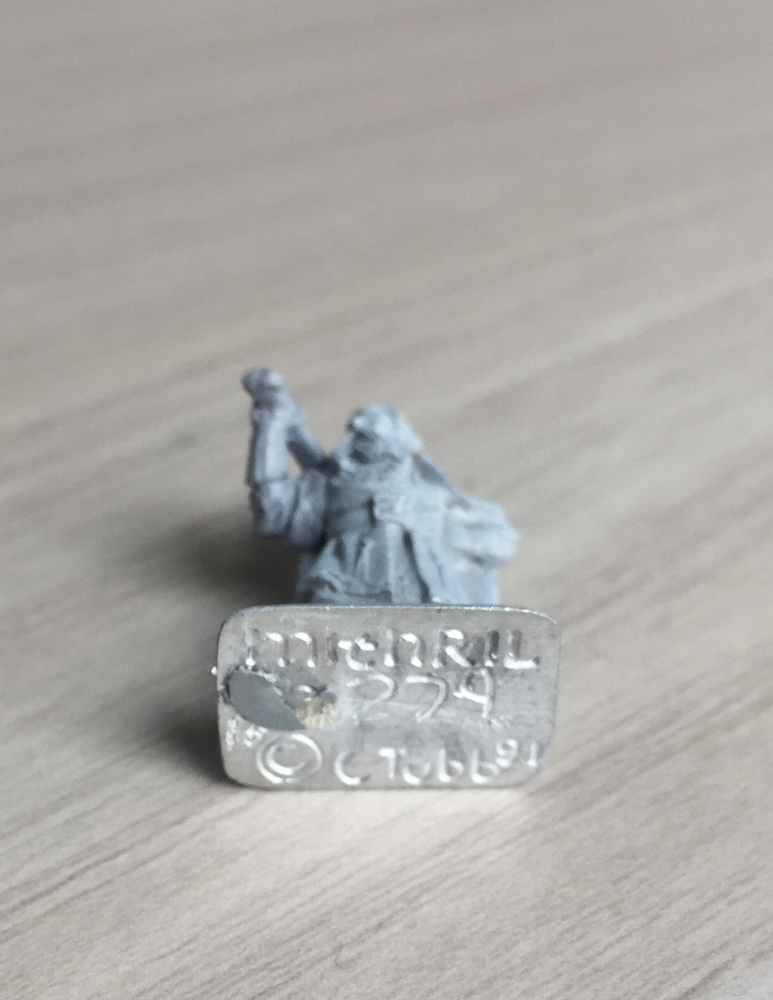
In this specific sculpt, Chris Tubb represented Thorin in fine clothes and holding on his shoulder the sword Orcrist. We may suppose this was meant to either represent Thorin during his stop at Rivendell, shortly after he recovered the sword from Hill Trolls in Rhudaur, or in Esgaroth, while he was a guest of the Master. The sculpt dates from 1991, as indicated on the base.


Thorin looks particularly relaxed and lordly, in line with the description of the Hobbit, where he is described as "an enormously important dwarf" and "very haughty". He drinks wine, plays a silver harp, does not help clean the table and holds a very long and institutional speech. I must say I really love how Tubb used he pose of the figure to bring out its character.

Now, allow me this short rant: Thorin's main characteristic is to be haughty. He is, after all, a very noble Dwarf, perhaps the noblest living in Middle-earth and Arda. He is heir of the kings of the Longbeards, the direct descendant of Durin the Deathless. He is pompous, sometimes arrogant, in a way obsessed with his inheritance and his family duty. But he is also a good leader, generous with his men, beloved by his people; he's smart, very good in talking his way out of situations, and yet keep his honour by not telling any lie; he can be aggressive, but he can be fun, too, laughing and singing with the other dwarves. He is just not simply a self-centered, brooding dick, as portrayed in the movies. I really hated how he came out there. Really, Thorin is such a great and complex character, PJ didn't do him justice. But then again, he didn't do justice to any character in the story, especially the grey-shaded ones.
Right, end of the rant.

It took me some time to decide how to paint it. The reasoning was that at Rivendell and Lake-town Thorin probably wore clothes that were fine but still not excessively rich: he was travelling after all. They should display deep colours, but not too garish. The only set thing was the hood: in the Hobbit, Thorin wears a "detachable hood" which was "sky-blue [...] with a long silver tassel". Now, this miniatures displays a cloak, not a detachable hood, but still here is the long silver tassel attached to the hood. I decided to go with it and keep the colours of sky-blue and silver.


The first layer of painting left me unhappy with the gold-rimmed cloak. That seemed too much for travelling clothes, so I changed that to silver as well.


Yes! I'm very happy with how the cloak turned out. Still room for improvement, but definitely better than the last one. The sword also looks nice - I painted it silver with a dark blue scabbard, to retain some "elvish flavour". I decided to leave the base pretty much disadorned, except for a dark green base and some lighter drybrush. This miniature will probably be used in games, so I don't want to add staff that will come off with heavy handling.

Look at the famous Thorin, son of Thráin, son of Thrór, heir of the Folk of Durin, gloating at the prospects of his homecoming to Erebor:
The King beneath the mountains,
The King of carven stone,
The lord of silver fountains
Shall come into his own!

His crown shall be upholden,
His harp shall be restrung,
His halls shall echo golden
To songs of yore re-sung.

The woods shall wave on mountains
And grass beneath the sun;
His wealth shall flow in fountains
And the rivers golden run.

The streams shall run in gladness,
The lakes shall shine and burn,
And sorrow fail and sadness
At the Mountain-king's return!

sabato 10 dicembre 2016

Review: Essex Byzantines

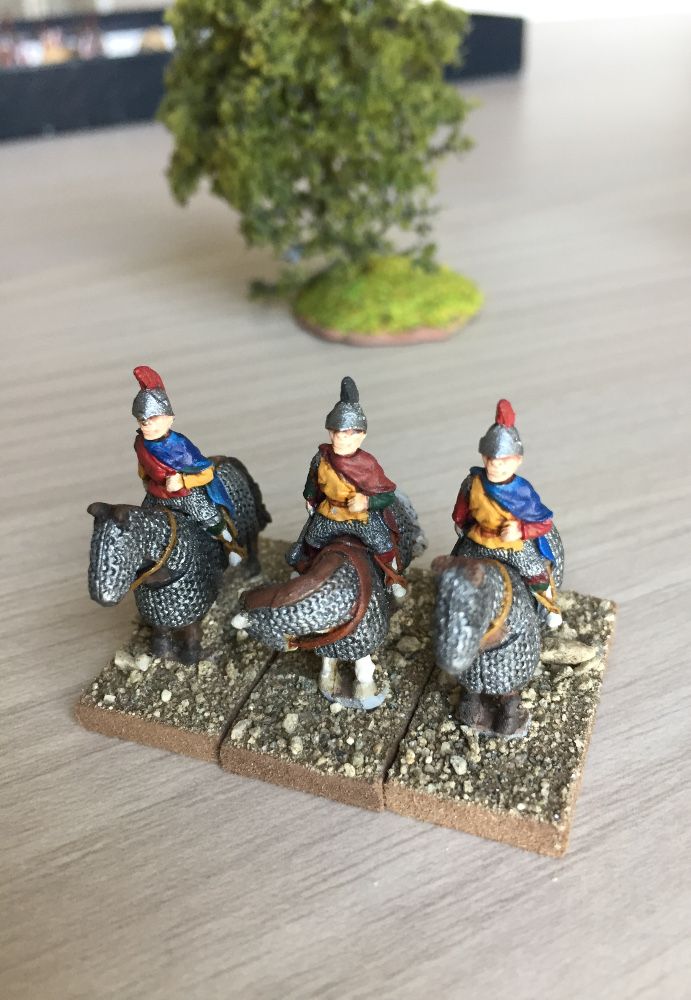
You might have seen them in the earlier battle reports, but here is the review of the 9th-11th century Byzantine force I built for my games.

The force is small and based on a few units, but I plan to expand it with more. Overall, I'm very happy with Essex Byzantines.

A few words on the company: it is a well-known manufacturer of 15mm and 25mm historical figures located in, well, Essex - southeast UK. They have exceptinal variety of armies and the price is very honest. Service is good and my items got shipped in a timely and efficient way.

Now, to the figures:

BZA01 - Byzantine: Command: Mounted General


Three figures, horseman and steed separated. Two different steeds, very well made. One, same figure for the horsemen. Seriously? They don't even look like Byzantines of that era, without armour and with a very simple helm. Armed with mace, no shield, a scabbard hanging from the side, under the cloak. Frankly speaking, I've seen better, but anyway.

BZA14 -  Byzantine: Kataphraktoi Extra Heavy Cavalry


These are not actually BZA14, since the shield is different - my figures have a kite shield, apparently not available anymore. BZA14 have a round shield. Everything else is the same.
Now I must say these miniatures are very nice - not like BZA01. They seem to respect history very well, and they have fine details and all. Again, they are four and all exactly the same. The horses have two poses, but again wonderful sculpt. Alas, the Essex website does not credit scultpors!

BZA17, BZA18 Byzantine: Skutatoi


Now the backbone of this force: the Skutatoi. These are my favourites. In every pack there are 8 pieces that are exactly the same BUT there are three different poses under different codes: BZA17, BZA18 and BZA25, so one can have some variety among the ranks. Additionally, the details on the figures allow for differentiation by colour:


BZA27 Byzantine: Varangian Guard 


These are also good: 8 figures with two poses, and fine detail. Historically realistic. Full of character, too.


They even have relief decorations on the cloak, Chinese brocade style.

All in all, Essex Byzantines are a good range and I'll be purchasing more of them. I'll probably need a command group and some archers, light cavalry and a couple more Caraphracts with different poses. Well done, Essex!

giovedì 1 dicembre 2016

GW Beastman Shaman (1993)


Vintage miniatures, again with this Citadel Beastman Shaman (73002/2) from 1993. Another nice lead miniature found on ebay.


And no wonder it's so fine - we are speaking of Mr. Michael Perry's art. The detail is lovely, especially the staff covered with a collection of Beastman and Human skulls.

Choosing the colour pattern wasn't easy. To be frank I'm used to painting good guys, and for this one I had to change my habits in order to set a creepier and darker mood. A search on Google Images helped, and the trick was rather simple but very smart - go for a low light source, such as the light of a bonfire. In other words, instead of painting the upper parts in lighter colours, I painted the lower parts of the figure, as if it was standing near a light on the ground.

'Cause Bestmen come at night, you fools!


In a way, it worked. I still have to practice more, with a darker undercoat and lighter highlights.


The base was completed with coarse construction sand and Swamp Tufts from Army Painter, just because the greyish colour goes well with a nightly setting.

I'm gonna use this one as the villain in some adventure with WFRP, or Zweihänder maybe. Beastmen are always good for a fight!

domenica 13 novembre 2016

Battle Report: Byzantine raid in southern Spoleto (Lion Rampant in High Middle Ages) 3/3

Continues from second part of the Battle Report
---------------------------------------------------------------------------

The Challenge
 
Theodoros Leontakephalos faces the gastald Arnald and his retainer Wigmund.

[After the third, terrible charge] At last the fight ceased, and as the dust cleared, only three horsemen still stood. Theodoros was covered in blood, a fierce lion, surrounded by the bodies of his men, of which only him remained. A few paces from him, Arnald was panting, his shield covered by marks of blows it had withstood and his eyes as wary as those of a wounded wolf. Beside him stood his retainer Wigmund, whose lance had been broken and was now wielding his sword.
It is said that all those who saw those men stopped their fighting, and a grim silence fell on the field.

"There is only one way we can end this, you and me!" shouted the Greek, in a clear Latin which he hoped his foe would understand. But even if Arnald didn't, the Pentakontarchos' gestures were clear to all. He pointed his mace of war towards the gastald, and prepared for the last charge.
"Do not accept his challenge, Sire" pleaded Wigmund "Greeks are a treacherous lot, and he knows his end is coming. We can take him down easily, together"
But Arnald would not listen to his friend. Raising his sword high, he shouted his battle cry and spurred his horse forward.

At that moment, on the other side of the hump, the fighters were oblivious of the confrontation of the two captains. The Frankish knights had finally reached the enemy and would charge the Skutatoi, who bravely stood their ground.

Before anything can happen between the two leaders, the Frankish knights on the other side of the hump have tested for Wild Charge and succeeded. They charged into the Skytatoi leaving two of their number on the groun; the Greek also lose two fighters, and as a draw the attacker must retreat. The charge of the knights have been repelled!

One again the Skutatoi prove their armour and discipline are stronger than the Frankish knights.
But nothing could stop Theodoros and Arnald as they rode towards each other. Theodoros laughed trimphantly as his mace struck the shield of the Gastald, but the laugh died in his throat when he himself had to defend against an attack more furious than he had expected. Theodoros retreated under the assault of Arnald, but his horse stumbled and, unbalanced, the Pentakontarchos was struck on the shoulder and lost his shield. Arnald's sword hit his black-crested helm on the side and slid towards the shoulder, finding its way to the neck. Leontakephalos, the Lion-headed, fell from his steed without a cry, and rested on the blood-soaked ground.

Arnald and Theodoros battle each other, as Wigmund watches in anguish.

Light is for Arnald, dark is for Theodoros.
 Challenges are pretty straightforward in Lion Rampant. Each throws three dies, scoring on 5-6. Whoever scores more, wins and kill the other. In case of a draw the parts are separated. Arnald scored three hits, against only one of Theodoros.
And now all Byzantine units must take a Courage test or run away.

"Victory to Spoleto!" cried Arnald, raising his sword and towering over the body of the Leontakephalos.
"Glory to Arnald!" echoed Wigmund "the Greek captain is dead!"

And this is how you win a battle like a Sire.
 The news of Theodoros's death swept through the battlefield like wild fire. Half of the Greek forces abandoned their weapons, together with all hope, and ran away, hoping to save their own lives at least by leaving the lands of the Spoletans.

The retreat of the Byzantines begins
The End of It
"For Spoleto!" cried the Frankish knights as they again charged into the remaining Skutatoi. This proved too much for the brave soldiers, and they also abandoned the field following their companions.

The Frankish knights on the other side of the hump tested again for Wild Charge and succeeded. This time they only lost one and fell three opponents. The Skutatoi were now forced to retreat and, losing a Courage test, also started routing.

More retreating happening

Only Audo and a half of those men who originally followed him now stood on the hump. Stubborn and proud, they understood the end was near, but refused to flee from the Franks. Instead, they decided to hold their position until the end, and die a honourable death. Their arrows, shot with the determination of the desperate, managed to repel the Militia.

One unit of Rustici still stood. A ranged attack on the approaching Militia killed one of them and sent the rest into retreat.

The Militia assails the hump

And is quickly repelled

Arnald, seeing his enemies driven before him, still did not rejoice. He had fulfilled his first oath, to have the head of the Greek captain, but now he would bring the second one to completion. Not one of the rebelling Lombards of the mountains would see his home. And so he and his knights hunted down the running footmen, so that only a handful of Skutatoi managed to escape the battle with his life.

Arnald and Wigmund charge into the retreating Skutatoi, who no longer benefit from the Shieldwall and, being battered, hardly fight back, and kill another one.

The Galstald gives no quarter
The other knights, having driven away the Skutatoi, charge into the retreating Rustici making easy sport of them. All of the Rustici are killed without any loss for the Franks.

Next time you won't challenge the Gastald again.
Audo's death
Audo and his kinmen now turned to face the knights. They prepared their swords and axes, and waited for the charge to come. Uphill rode the knights, their lances lowered. As the sun set, the last of the mountain men wet the hump with their blood.
Now Arnald's victory was complete.

No matter the higher terrain, if Rustici are charged by knights, the outcome is pretty simple.

Up the hill go the knights
Down the hill go the Rustici

Epilogue
Three days later the few survivors of Theodoros's force reached the army of the Strategos, reporting the events. By that time, the Leontakephalos's head was gracing the main square of the nearest town, on a pole, witness to all that the Gastald would bear no offense. Next to him, the heads of the rebels of the mountains. Their kinmen fled their mountain homes, rightly fearing the Gastald's retribution, and settled again in the lands of the Princes of Benevento.
The Marquis of Spoleto was pleased to hear the reports of the battle, and sent the Gastald a horse as a gift, and the grant of various lands to be held in beneficium.

The game was fun. All in all, it took a couple of hours. It was fast paced and dramatic. Next time, I'll try it with a scenario and, possibly, an opponent.

I hope you enjoyed reading this report and please leave a comment - feel free to send opinions and notes: being my first game, I may have overlooked some rules. If you want to know more about my house rules to play in the 10-11th century, let me know and I'll post you.