Visualizzazione post con etichetta Review. Mostra tutti i post

mercoledì 26 aprile 2017

Review: GW High Elf Prince and Noble (2/2) - The Noble

A few month later, we conclude the Review on GW High Elf Prince and Noble, talking about the second miniature of the box, the Noble (the link to the first part is here).


Like the mounted Prince, also the Noble is highly customisable with different heads, shields, banners and weapons. And that's very good.


One thing is clear from the beginning: besides being sculpted by the same guy, Martin Footit, this figure is very different in two interconnected elements. First, whereas the Prince is a very dynamic sculpt, the Noble is extremely static: feet to the ground, arms to the side, looking forward, almost waiting for a faraway enemy to approach. It reminds me of the very old '80s High Elven infantry of the early editions, in a way, and it's obviously related to them. To me it's not so enticing: Elves are supposed to be nimble, fast, not statuary, but that's me.
Second: the Noble is as solid as rock. Once you put it together, it's unlikely that it will break or snap, like it happened several times with the Prince. It's plastic alright, but it withstands manipulation and this makes me very happy since I'm planning to use this figure in my next D&D game as a PC.

The PC in question is my Noble Elf Fighter (right, what a surprise!, you might say). Valandur Isirmo of the House of the Ivory Tower of Elventown in the Mountains of the Stars.

Don't you recognize me by the colours of my livery?
Valandur is a young Elf. Not young by Human standards but, as Elves reckon, he's just entered that age when young Elves discover the world and act naively and stupidly and recklessly and just as a Human male on the last year of high school or the first year of university.

Valandur is a nobleman, of course, from a prestigious house of a prestigious city of the most prestigious race, the Elves. The Sun Elves, of course, not the other lesser ones. But in spite of his origins he's not a cunt like everybody else where he comes from. 'Right, not as much as everybody else in Elventown. In fact, Valandur is on a quest to prove himself.

It so happened that he quarreled with another young Elf of his age, the odious Prince of the Elves, none other than Legoland the Handsome, son of the King. If you look on an elven dictionary at the word pharagrand (high elvish for "cunt") you will see Legoland's portrait. He's just this guy. Valandur hates him.
Long story short, one day as Legoland was coming back from a hunt with a dead wyvern as trophy, and people were throwing rose petals at him from the balcony, words escalated and Valandur said killing wyvern was for noobs, and that he could easily slay a dragon. Legoland's reply was a slap on the offender's face with his pailette-covered white glove. Challenge issued.

Young Valandur had no choice but to go, especially since the episode happened right in front of Morwen Elentilas, the proud lady whom everybody was courting and whose attention none was getting.

And so Valandur hit the road, and he started a life of adventures along with other valiant companions - Rothgar, a Dwarfish barbarian; Negal, a halfling assassin; and Loras, a half-elven rogue. It was a hard life of travel through the wild lands and battles with monsters and outlaws. But it was fun, and soon Valandur developed a reputation for being as easy to provoke a challenge as he was in spending all the money he had. Offering toasts at all the patrons of inns was one of his favourites, especially right after a bar-fight. Expensive clothes, fine food and wines, fancy accomodations and the expensive love of an elven princess-turned courtesan, Ahlahna of Neverwinter, made sure he money never stayed long in his pockets, but everybody knew his name, though, and that was the important thing!

At last, the party met a Dragon, a green one, and by sheer luck they slew it. Valandur had the head preserved by a taxidermist and turned homewards. As soon as he arrived in Elventown, he was welcomed by the people with cheers. He rode on a cart, covered in shining armour and garish clothes, the Dragon head behind him held by a stuffed Owl-bear. He threw coins at the crowd getting even more cheers.

Legoland didn't like it, and liked it even less when he got his own glove thrown at his face. The King had to accept the gifts graciously and commended the valour of Valandur. It was the elf's moment of glory, but it wasn't finished: the elder Elves, less interested in showing off and more into power-mongering, made it so that Valandur and Legoland were both candidated at the position of Speaker to the next Great Moot of Elves. And how would they settle the opposition? By vote? By a speech? By a gallant joust?

It is SO on.
Valandur and Legoland were so high on testosterone that they could only choose a fight. The two rivals met each other in the Arena, each covered in tight, bright garments, shiny pieces of armour and battle make up (rimmel, phard, bright-red lipstick and random hearts and spades drawn on cheekbones). Their nervous, darting muscles had been oiled with the special glitter-oil of the Elves.
Valandur was obviously better with the spear, his fighting technique mimicking a dance, but Legoland was a spellcaster and could strike at his opponent without even touching him. But eventually it was Valandur who had the upper hand, and Legoland found himself disarmed. Proudly refusing to yield, the Prince choose to fight without a weapon: in return, Valandur threw away his spear and jumped at him with his bare hands - well, not so bare, since he had Gloves of Ogre Power. A few good strikes, and Legoland was thrown to the ground, where he bit the dust.

The crowd exploded with cheers. Valandur was raised and paraded around the Arena by his supporters. When even Morwen threw her scarf at him, he jumped on the terraces and rewarded her with a full kiss that drew even further cheers (and a few deadly stares by her relatives).

And so the legend of Valandur began.

It wasn't easy to capture the full razmatazz of a character like Valandur with a static miniature like this. I decided to go for few, bright colours - white, blue and green, with some touches of yellow. The first hand was disappointing.

Even though I started with dark and dull colours, the figure isn't really helping to look lively. It needs a certain effort. I painted the armour in metal with black details, decorating some elements in green (the green dragon). The clothese are blue and white. In order to avoid too many colours I kept the gems as mily opals and onlu added some ochre yellow here and there. But before the end I had to add some gold here and there to brighten up the whole.

After a general wash and at least two layers of highlight, something started to come out. But it was the third highlight layer that did the job.


Final vote: 7/10. Good, but not great - there a lot of better miniatures for Elves, even in the GW range. I really do hope that AoS will refresh the image of the Aelves by more than adding an "A" in front of the name, but looking at what they're doing lately, I must say I am very hopeful. We shall see!

sabato 10 dicembre 2016

Review: Essex Byzantines

You might have seen them in the earlier battle reports, but here is the review of the 9th-11th century Byzantine force I built for my games.

The force is small and based on a few units, but I plan to expand it with more. Overall, I'm very happy with Essex Byzantines.

A few words on the company: it is a well-known manufacturer of 15mm and 25mm historical figures located in, well, Essex - southeast UK. They have exceptinal variety of armies and the price is very honest. Service is good and my items got shipped in a timely and efficient way.

Now, to the figures:

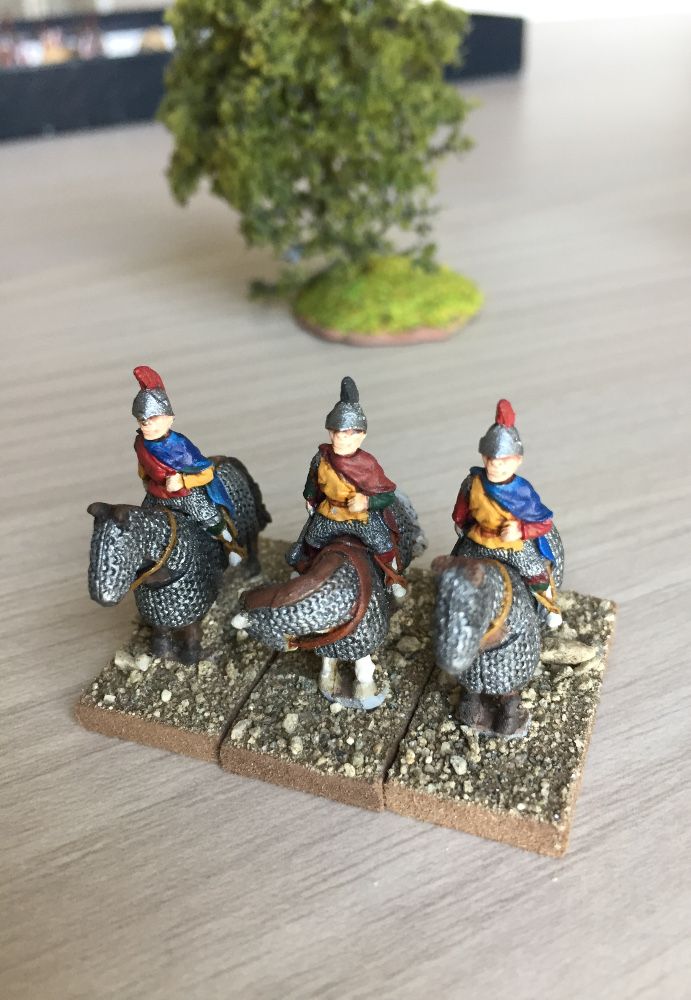
BZA01 - Byzantine: Command: Mounted General


Three figures, horseman and steed separated. Two different steeds, very well made. One, same figure for the horsemen. Seriously? They don't even look like Byzantines of that era, without armour and with a very simple helm. Armed with mace, no shield, a scabbard hanging from the side, under the cloak. Frankly speaking, I've seen better, but anyway.

BZA14 -  Byzantine: Kataphraktoi Extra Heavy Cavalry


These are not actually BZA14, since the shield is different - my figures have a kite shield, apparently not available anymore. BZA14 have a round shield. Everything else is the same.
Now I must say these miniatures are very nice - not like BZA01. They seem to respect history very well, and they have fine details and all. Again, they are four and all exactly the same. The horses have two poses, but again wonderful sculpt. Alas, the Essex website does not credit scultpors!

BZA17, BZA18 Byzantine: Skutatoi


Now the backbone of this force: the Skutatoi. These are my favourites. In every pack there are 8 pieces that are exactly the same BUT there are three different poses under different codes: BZA17, BZA18 and BZA25, so one can have some variety among the ranks. Additionally, the details on the figures allow for differentiation by colour:


BZA27 Byzantine: Varangian Guard 


These are also good: 8 figures with two poses, and fine detail. Historically realistic. Full of character, too.


They even have relief decorations on the cloak, Chinese brocade style.

All in all, Essex Byzantines are a good range and I'll be purchasing more of them. I'll probably need a command group and some archers, light cavalry and a couple more Caraphracts with different poses. Well done, Essex!

mercoledì 19 ottobre 2016

Review: GW High Elf Prince and Noble (1/2) - The Prince


This is the first pure plastic miniature I purchase and may I say "I do miss the metal ones".

I mean, what are the benefits?
Are they cheaper? No. They cost exactly the same as before, if not more.
Are they more handy? No. They have almost no weight and are easy to topple.
Are they stronger? No. They break at any gentle pressure.
Are they durable? No. Try to remove the paint with some acid and you'll remove the plastic too.
Are they more environmentally friendly? Granted, lead was poisounous, resin was a bit better, but don't tell me plastic, a byproduct of oil industry, is green.

For the consumer there are really no benefits. There are, of course, a lot of benefits for the seller. First one, plastic is way cheaper if manufactured in large quantities. A plastic moulding machine is expensive, but plastic itself is really cheap; there are huge fixed costs, but the variable ones are almost nothing. And that's why small companies are still using resin, and the giants like GW moved on to plastic. The second benefit is that plastic is really light, and that matters when you ship stuff abroad.
 

But here we are, opening the box of the High Elf Prince and Noble (Product Code 99 12 02 10 008, year 2013). Inside the box there are two sprues, containing all the pieces for two miniatures. The first thing I really like is that there are a number of double pieces, namely heads and weapons, but also cloaks, to let you customize the miniature. This makes a lot of difference, and I really like it.
I'll be starting with the mounted Prince and leave the Noble for a later time.

It takes some time to put together the final thing, but at last we get there. On one side, the horse; on the other, the Elf Prince. It takes a long but pleasant time to paint this miniature: there are plenty of small details and the structure makes it relatively easy and fun to paint them. Well done, Martin Footitt! But then one thing happen: the horse breaks. For the first time.


The thing is that this bloody horse is jumping, and is connected to its base by a single leg, a plastic leg. If you hold the base with a finger and the tail of the horse with another, no matter how gently, snap! It's broken. So it's glued again.


I decide to keep it simple and use red and white as the primary colours of my Prince, modelled after one of the PCs of my Warhammer Fantasy Roleplay, Celebril of Caledor, Knight-Errant, Noble and Bane of Chaos. I paint the armour as shining metal, with a steel base and silver highlights, using gold on details. The horse will be white as well, with a light golden tail, replicated on the helm of the hero.
 

The interesting part is the blade. In the WFRP campaign, Celebril wields a magic sword, the Gayvenderel or Crystal Sword. To give the effect of crystal, I painted many layers of glaze going from black to white with a glass colour in the middle, a mix of Vallejo Pastel Green and Grey Blue. I finished with some parallel strokes to represent the uneven structure of crystal. Overall, considering it's a first try, I am quite pleased. Less pleasing are the spikey grasses I add on the base - could have been better, but at least they match the colour of the horse's tail.
 

Isn't it a beauty? It is, after I glued the leg of the horse twice more.

Final judgement? The miniature looks great, but it is so weak I am really afraid when I hold it, and also I will never let my kids (or clumsy friends) near it. Using it in a game is out of question. This kind of miniature can be only kept on a shelf for display, and that goes against my idea of having miniatures. So it's a 5/10. If it was metal, it would be probably an 8, but the stupid fragility of the thing is unforgivable. Dear GW, make your miniatures in metal again or, if you don't want, consider avoiding jumping poses. I know I will, with your future products.

domenica 4 settembre 2016

Large Warg (Mithril M25)

Warg!
...and he's coming at you!
Wait, what is a Warg, anyway?
Well... you know... that's a large wolf, I guess. Large fantasy wolf. Right?

Sounds about right!
There seems to be some confusion about wargs, for a number of reasons. To some, Wargs are large wolves; to other, they are super-wolves, related to common wolves in the same way a tiger is related to a wild cat. To other still, Wargs are supernatural wolves,endowed with special powers: in MERP, for example, True Wargs are essentially undead spirits. And then, there are werewolves, of course - are they even related to Wargs?

Let's look at what Tolkien tells us, starting with the Hobbit:
"All of a sudden they heard a howl away down hill, a long shuddering howl. It was answered by another away to the right and a good deal nearer to them; then by another not far away to the left. It was wolves howling at the moon, wolves gathering together!
     There were no wolves living near Mr. Baggins' hole at home, but he knew that noise. He had had it described to him often enough in tales. One of his elder cousins (on the Took side), who had been a great traveller, used to imitate it to frighten him. To hear it out in the forest under the moon was too much for Bilbo. Even magic rings are not much use against wolves-especially against the evil packs that lived under the shadow of the goblin-infested mountains, over the Edge of the Wild on the borders of the unknown. Wolves of that sort smell keener than goblins, and do not need to see you to catch you! [...]
"But even the wild Wargs (for so the evil wolves over the Edge of the Wild were named) cannot climb trees. [...]"
Hob
 Tolkien makes quite clear that Wargs are wolves. Not similar, mind me: they are a kind of wolf. What made them different to other kinds, then?
"The Wargs and the goblins often helped one another in wicked deeds. Goblins do not usually venture very far from their mountains, unless they are driven out and are looking for new homes, or are marching to war (which I am glad to say has not happened for a long while). But in those days they sometimes used to go on raids, especially to get food or slaves to work for them. Then they often got the Wargs to help and shared the plunder with them. Sometimes they rode on wolves like men do on horses."
Hob
Well, for a start, they developed an alliance with the Goblins and even let them ride them! Earlier on it is said in the book that the Wargs had a "dreadful language" of their own, which people could learn: at least some Orcs did, and so did Gandalf. Not that regular wolves didn't have their language: in the Hobbit, it seems a lot of beasts and birds have their own speech.

Wargs were probably well more intelligent and cunning than other wolves, considering they held meetings, planned raids on the woodmen and even stationed guards at the feet of trees where the Dwarves had climbed. We are also told that they ran "swifter than ponies", and that with an Orc on their back, so we can assume they were rather big and strong.
In fact is seems that the Wargs had developed their friendship with Orcs and Goblins so much that somebody even developed a proverb in Westron about that.
"[...] where the warg howls, there also the orc prowls.'
FotR
But there is another creature, similar to the Warg, that is first mentioned in the Fellowship of the Ring:
"[...] Not all his servants and chattels are wraiths! There are orcs and trolls, there are wargs and werewolves. [...]"
FotR
Now, this is unfortunate, in a way. Tolkien developed Wargs for the Hobbit, drawing from the word from Old English wearg, which meant "wolf". But earlier than that he had developed werewolves in the Silmarillion (see later), and the word werewolf is derived from the Old English werewulf, with wer- meaning "man, person". The two words are quite different, but they were translated in many other languages as exactly the same: in Italian, for example, they are Mannari; in French, Loups-garou.
We seem to meet werewolves when the Fellowship of the Rings travels from Rivendell to Moria.
"In the dead of the night many shining eyes were seen peering over the brow of the hill. Some advanced almost to the ring of stones. At a gap in the circle a great dark wolf-shape could be seen halted, gazing at them. A shuddering howl broke from him, as if he were a captain summoning his pack to the assault.
"Gandalf stood up and strode forward, holding his staff aloft. 'Listen, Hound of Sauron! ' he cried. `Gandalf is here. Fly, if you value your foul skin! I will shrivel you from tail to snout, if you come within this ring.'
"The wolf snarled and sprang towards them with a great leap. At that moment there was a sharp twang. Legolas had loosed his bow. There was a hideous yell, and the leaping shape thudded to the ground; the elvish arrow had pierced its throat. The watching eyes were suddenly extinguished. Gandalf and Aragorn strode forward, but the hill was deserted; the hunting packs had fled. All about them the darkness grew silent, and no cry came on the sighing wind.
"The night was old, and westward the waning moon was setting. gleaming fitfully through the breaking clouds. Suddenly Frodo started from sleep. Without warning a storm of howls broke out fierce and wild all about the camp. A great host of Wargs had gathered silently and was now attacking them from every side at once."
FotR
Apparently, these are regular Wargs, but something odd happens, after the wolves are routed again:
"When the full light of the morning came no signs of the wolves were to be found, and they looked in vain for the bodies of the dead. No trace of the fight remained but the charred trees and the arrows of Legolas lying on the hill-top. All were undamaged save one of which only the point was left.
"`It is as I feared,' said Gandalf. `These were no ordinary wolves hunting for food in the wilderness. Let us eat quickly and go!"
FotR
What were those things? Although more than one had been slain, they left no bodies. Were they incorporeal? Did the surviving Wargs carry away the bodies of the dead? Well, we don't know, but we may suppose these things were werewolves.
Regular Wargs were certainly not incorporeal: Beorn at least took pride in skinning them and nailing their hides to trees.
Don't need supernatural powers to scare anybody! Growl!
 In the Silmarillion, ironically, the word Warg is never used just because it had been written before the Hobbit. But the idea of regular wolves and supernatural werewolves is already quite clear:
"And ere long the evil creatures came even to Beleriand, over passes in the mountains, or up from the south through the dark forests. Wolves there were, or creatures that walked in wolf-shapes, and other fell beings of shadow [...]"
Sil
A definition of werewolves is offered at the beginning of the tale of Beren and Lúthien:
"[...] werewolves, fell beasts inhabited by dreadful spirits that he [Sauron] had imprisoned in their bodies."
Sil
Sauron was, apparently, the creator of werewolves, so much that he was called "Lord of Werewolves". He conquered the Minas Tirith, the fortress of Finrod Felagund built on an island on the upper Sirion, and turned it into Tol-in-Gaurhoth, the Isle of the Werewolves. We see there was a specific word in Sindarin, Gaur (pl. Gaurhoth), to describe the werewolf, well distinct from the regular wolf, Draug.
It is interesting to note that Drauglin, "a dread beast, old in evil lord and sire of the werewolves of Angband" is never described as a werewolf, even if he is "sire of werewolves". But when Beren using his wolf-hame masks himself, he "became in all things like a werewolf to look upon, save that in his eyes there shone a spirit grim indeed but clean". Sauron, too, when he shapeshifts, "took upon himself the form of a werewolf". It seems to me that the essence of a werewolf, a Gaur, was to be wolf in body but not in spirit.
So the wolves that attacked the Fellowship on the way to Moria were probably werewolves. What happened to them and their bodies? Well, what I think happened is that the bodies were killed, but the evil spirits were still there; by using their powers, the spirits carried their own butchered bodies away, like undead, so they were not left on the site.
No need to imagine ghost wolves, which by the way wouldn't even be able to hurt anybody, being ghosts and the like; and that at any rate would never be wounded by an arrow at all. From what we gather, wargs and werewolves were induistinguishable at first sight, the only difference being their spirit.
That, of course, means that this miniature can also represent a werewolf.
Care to test me, dear? I may yet surprise you.
Having drawn the line between Draug and Gaur and established that they look one and the same, let's have a look at how are these creatures are represented in other media, shall we?
The Hobbit animated movie, 1977. Could have been worse.

Pauline Baynes, Bilbo's Last Song, 1990. The Authority.
The Two Towers, 2002. That doesn't even look like a wolf.

The Hobbit: An Enexpected Jorney, 2012. Better, but weird.
 No, ok, I am partialy to Paline Baynes, but Tolkien was, too, right? I like the take of Mithril on Wargs. They look very realistic. Not terribly easy to paint, given the fur's texture is not very deep, but still pleasing.
These are the alternatives:

 
Easy and fun to paint, still weird and not very wolf-like, in my opinion.

Now, a look on proportions:
32mm: that is a BIG wolf, now!
15mm: another reason to hate that f***er Sauron.
As you can see, it works both ways, depending whether you want to play First or Third Age, Well, that's all to say. Have a nice day and, remember, don't talk to strangers in the woods!
Off to Grandma's House while you pick flowers. See you!

mercoledì 3 febbraio 2016

Review: Baueda vs. Essex Carolingian Era Knights

It took a year, but it is done. I have finished painting my Carolingian knights, and here we are presenting them.
These figures were taken from two compatible suppliers, Baueda and Essex.

Let's start with the latter:

Essex DGS1 - Dark Age: Heavy Cavalry in mail with lance and round shield


These are lovely figures: extremely realistic and detailed, both riders and horses. They could represent most European heavy cavalry between 750 and 950, milites protected by chain mail and open helms, armed with spears and round shields.

Essex DGS2 - Dark Age: Heavy Cavalry in mail with assorted weapons & round shield


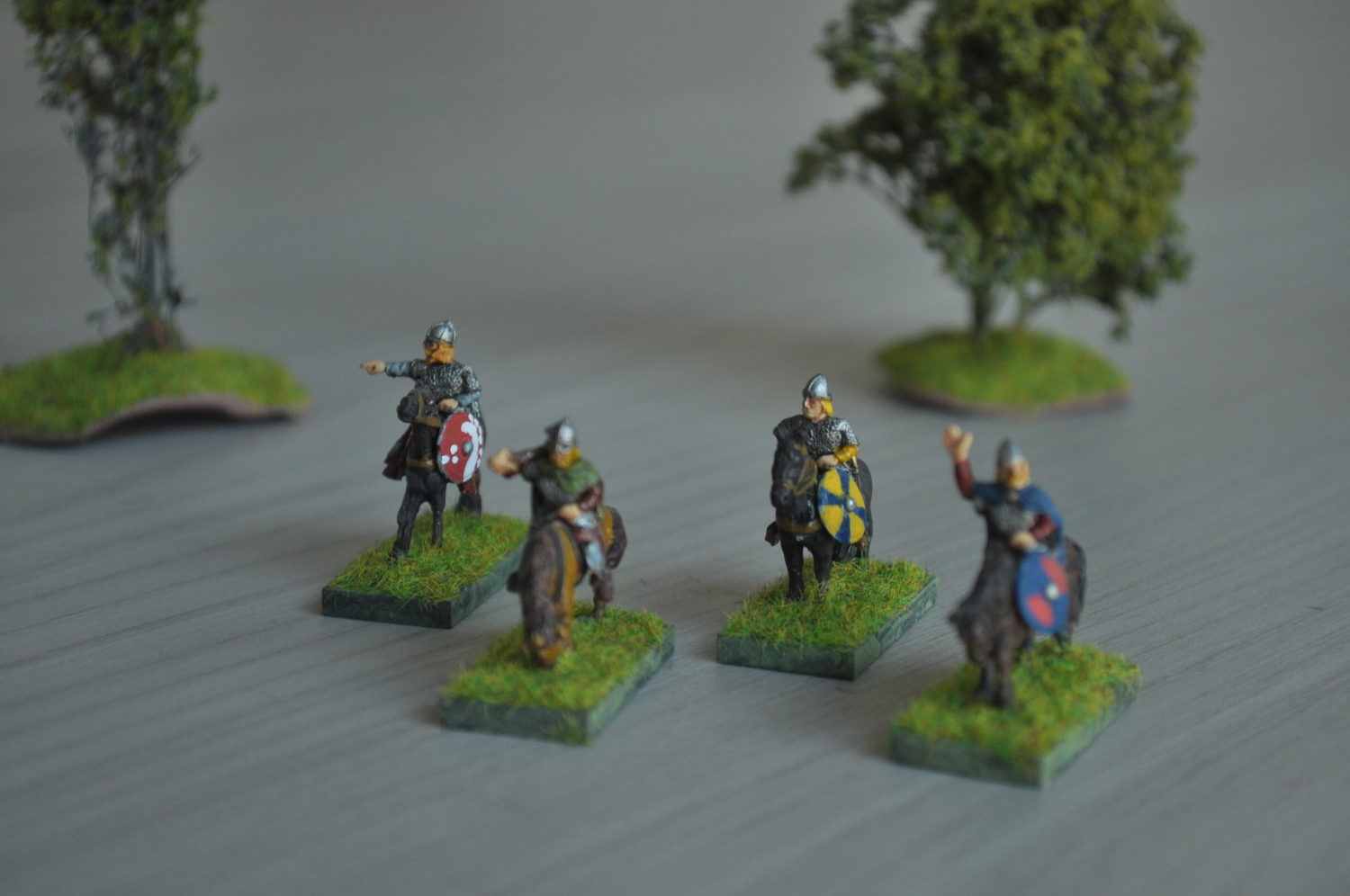
These are leaders: two of them look like generic west European knights from the Carolingian and post-Carolingian era, while the other two wear helms with visors making them resemble Norman horsemen. The poses are beautiful, four different ones, and the horses are again great.

Baueda CRL1 - Carolingian Mounted Command


Speaking of leaders, here are the Baueda captains. The miniatures from this producer look more stylized than the Essex ones, with more strinking but less realistic details. There are four poses among the riders and all of them are very well done; and 3-4 poses among the horses. Oh, the horses: sorry Baueda, your horses are not the same as Essex; they are very crude, and I'm being generous. Those that you see in the pictures are actually Essex since I felt bad using Baueda ones with the riders, who are actually beautiful, but you'll see below what I'm talking about.
The Command Group from Baueda well represents the élite of an armed force: counts, gastaldi or sculdasci in charge of a retinue.

Baueda CRL3 - Carolingian Caballari


Caballari, on the other hand, are generic knights armed with a lance and a round shield, and protected by mail armour. These riders (three poses) are less well sculpted than the Command Group, but still nice; but then you see the horses: two poses, and not at all well done.

Baueda CRL4 - Swabian, Bavarian or Thuringian Caballari


The same could be said for the CRL4, with very well detailed, if stylized, riders and mediocre mounts. These are horsemen armed with swords and shields.

Now, let's draw some conclusions: which are best? I like them both, I would say. Essex minis are more proportionate and realistic, but Baueda minis are more varied, easier to recognize in the crowd of other figures, and funnier to paint; the Command group is delightful; but their horses suck. So it really depends on personal taste, I would say.

Both lines are 100% compatible: just compare DGS2 and CRL1.


These are incidentally some of those that I really like (again, CRL1 horse is actually stolen from Essex set).

But here are some extra pictures, just to show off the painting, because this time I'm quite proud of them and I'm not sure next time they'll be as good!

Essex Normans, the horse on the right is actually Baueda


A better view of the command group CRL1, only the white horse is Baueda, the others are all Essex