Visualizzazione post con etichetta Watercolour. Mostra tutti i post

lunedì 12 novembre 2018

Fantasy Visuals: Jeff Jones


Jeff Jones, sometimes referenced as Jeffrey Catherine Jones, was a US artist that worked in the 1960s and 1970s, doing comics and fantasy art. Although not as famous as other of his contemporaries, he was a greatly talented and respected illustrator.

He was born Jeffrey Durwood Jones in Atlanta, Georgia, on 10th January 1944, the son of a US Army soldier. He spent his youth in Atlanta and then enrolled in Georgia State College: there he met his future wife, Mary Louise Alexander, and the two married in 1966, having a daughter, Julianna, the following year. Jones graduated in that same period, in 1967, as a geologist. His great interest, though, was art and soon he left Georgia with his family and moved to New York City where his talent was immediately recognized: in that same year he was nominated for the Hugo Award to the best fan artist. He started drawing comics and then covers for sci-fi and fantasy books and his career immediately took off. But things were not easy for the family, and in the early 1970s he and his wife divorced.

I wish I was there (1969)

Ceremony (1970)
From 1972 to 1975 the National Lampoon gave him a full page for a strip titled Idyl.


In 1975, Jones joined the Studio, a collective workspace in Manhattan shared with Bernie Wrightson, Barry Windsor-Smith and Michael Kaluta. This was one of the first experiments of shared space for artists, which ensured their independence from corporate constraints, and was soon imitated by many other groups.


In 1979 Jones left the Studio, after publishing a volume with their collective work. In 1980 he received a full page strip in Heavy Metal titled I’m Age. 


Yet at that time Jones was already developing an interest in Expressionism and gradually losing interest in comics.


In 1986 Jones received the World Fantasy Award as best artist.

Since childhood, Jones had not felt comfortable being a man and he secretly wished to be a woman. In 1998 he confronted these issue and started hormone replacement therapy and legally changed his gender, taking the name of Jeffrey Catherine Jones. The transition was not easy and in 2001 Jones suffered a nervous breakdown which brought to the loss of her studio and home. It took three years to recover, but in 2004 she resumed painting and drawing again.

Jones died on 19th May 2011 from severe emphysema and bronchitis.

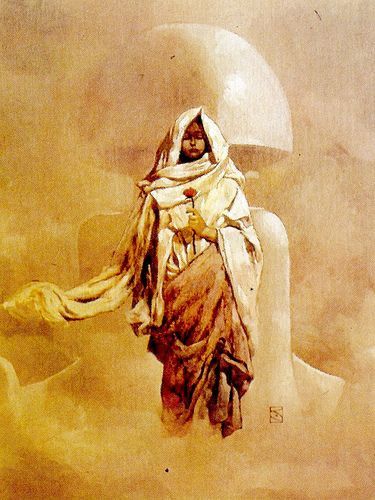
Jones was a master of styles and during her career she experimented with many of them, notably pencils, ink, oil and watercolours. Reputedly Frank Frazetta called her “the greatest living painter”.


Jones’s style was heavily influenced by Frazetta in subject and form: she was fond of drawing naked bodies of warriors and amazons and great beasts, applying heavy light and shadow and using simple, monochromatic backgrounds. But Jones’s art was somewhat lighter, more playful and positive, especially on his women. He once declared “I am a romantic and a painter and I love women… The female form just reflects light so simply and beautifully,”. 


In her later years, her style veered towards more delicate and personal subjects, especially portraits of women.


giovedì 7 settembre 2017

Fantasy Visuals: Roger Dean


While fantasy artists on the western shore of the Atlantic focused on portraying faithfully the bodies of heroes and villains, something different was happening on the other side of the Ocean and namely in England.

This country already had a rich tradition of fantasy illustration dating from the end of the 19th century, with Arthur Rackham and other artists giving form to fairy tales and, somehow, inherited a very different approach to fantasy art, one that was more related to the general feeling and atmosphere offered by an illustration rather than the story it told. Roger Dean was one of the earliest fantasy artists in UK, and he started to become famous more or less at the time of Frazetta in the US.

Dean was born in Ashford, Kent, in 1944 but he spent his childhood travelling with his family (his father was in the Army). Only at 15 did Dean settled down again in England; he studied at the Canterbury College of Art and later at the Royal College of Art where he graduated in 1969 with a thesis on 'The psychology of the built environment'. Dean was not interested specifically in Fantasy literature, but rather in landscape and designs, and yet his work has had a huge impact on Fantasy Art.

Not only his paintings, on which we will focus on this post, but also his designs, at which it’s worth taking a quick look. Roger Dean’s first project was finished while he was still in University: in 1968 he presented his Sea Urchin chair.


Later he came out with a new idea, which was seminal for his work in design: the Retreat Pod. This is a piece of furniture that could be presented as a chair or a sofa, but it is much more: essentially, a closed space where a person can “retreat” like inside a womb, a personal space for concentration and imagination. This was groundbreaking at the time, so much that even Stanley Kubrick wanted one of those in his movie Clockwork Orange (1972).


The concept of the Retreat Pod evolved from piece of furniture to living space. With the project Home for Life, Roger Dean and his brother Martin created a concept for a new kind of housing - cheap, sustainable and beautiful. It has evolved ever since and, at the time of posting, Dean is still working on it making it larger and better.


But enough of this - what we want is pictures, illustrations, paintings. Dean worked mostly with watercolour (I know, so British!) with occasional experiments with gouache, ink and crayons. The first famous painting Dean produced was produced again in 1968, the year before he graduated - it was the cover for a Progressive Rock band, Gun.


This was the first of a long list of album covers the artist did. He worked mostly with prog bands, so much that his style became a sort of trademark for the genre, but he occasionally covered other genres, too.

Ramases - Space Hymns (1970)

Earth and Fire - Earth and Fire (1970)

Billy Cox - Nitro Function (1971)

Osibisa - Osibisa (1971)
Midnight Sun - Midnight Sun (1971)
 
Yes - Close to the Edge (1972)
Uriah Heep - Demons and Wizards (1972)
Uriah Heep - The Magician's Birthday (1972)

Yes - Awakenings (1972)

Yes - Escape (1973)

Yes - Tales from Topographic Oceans (1973)

McKendree Spring - Spring Suite (1973)
In 1972 Dean designed the first Virgin logo, which the company used for it debut until 1977, the period when Progressive Rock was big. When Punk became the next thing and Virgin signed the Sex Pistols, the logo became the one we know today.


In 1985, Dean started his cooperation with a software house, Psygnosis, for which he designed logo and developed concepts. He designed the covers for the boxes of Obliterator (1988), Shadow of the Beast (1989) and Ork (1991).


For all his life so far, Dean painted almost only landscapes - the occasional living things or vehicles had the only purpose of providing perspective and proportions to the whole. This was the opposite approach of his American colleagues.
Light, brightness and haze play a very important role in all his work: they provide depth and give proportions to what we see, and at the same thy evoke a mood. Dean learns directly the lesson of Romantic painters, like C.D. Friedrich: sometimes a sunset, a misty veil or moonshine in the background can be the very the centrepiece of a work.

Alpha - Asia (1983)

Blue Desert (1989)

Yes - The Ladder (1989)

Asia - Aura (2000)

The Old Brige (2006)

Black Moth - Condemned to Hope (2014)
As said before, despite never actually basing his works on Fantasy sagas like Lord of the Rings or Conan the Barbarian, Roger Dean has been a huge influence on all Fantasy artists who came after him, especially British ones. But his influence has been even greater on science fiction. Look at the following couples of images and tell me if you think they are related.


Chances are you answered "yes". In 2013 Dean filed a legal case against director James Cameron about Avatar, claiming - quite reasonably, if you ask me - that most of the landscape art was a total rip-off of his work in the last 40 years. Less reasonable was the compensation he asked for - 50 million US$. The filmmakers admitted being influenced by Roger Dean, but not so much to owe him money, on which the court agreed, so that in 2014 the case was dismissed.
 
One thing Dean never worked on, as far as I know, is Stanislaw Lem’s Solaris. But I remember all the time I was reading it, I had in mind Dean’s landscapes. This is the only way I can imagine the fantastic structures created by the planet. Pity it didn’t happen - if you ever read us, Mr. Dean, please do a watercolour of a Mimoid. Pleaaaase.

Lighthouse - One Fine Morning (1970)

Electric Sheep (2004)

Yes - Like it is (2014)
What do you think of Roger Dean’s art? As usual, to close the post, here are my favourite pieces. They all share the same visionary majesty of an architecture that blends with the surrounding nature, and at the same time dominates it. The light is used to perfection to create depth and perspective, and at the same time evoke a sense of mystery all painting share - don't you feel an urge to go forward, to explore these outworldy and beautiful landscapes? This is what Fantasy is all about to me. Roger Dean simply nails it.

Jade Sea (1976)
Troll Home (?)

Green Towers (1981)
Freija's Castle (1987)
The Ladder (1999)