Visualizzazione post con etichetta Warhammer. Mostra tutti i post

lunedì 19 ottobre 2020

Fantasy Visuals: John Blanche - Part III (the '00s)

Follows from Part II.

While the '80s were an age of experimentation and the '90s a time of development of a visual language for a new setting, the following decade saw John Blanche sit back and let the other artists of GW proceed along the route he set.

A turning point of Blanche's influence on Fantasy is probably Mordheim, published in 1999. This is the moment when the Old World stops being anything else than Blanchitsu. It's medieval fantasy Necromunda, on steroids. It has all the elements: deformity, madness, skulls, spikes, scrolls used as garments and oversized weapons. In one word, Grimdark.


After Mordheim the way is finally paved and Warhammer Fantasy's frames are drawn. Not that there isn't space for creativity within the studio, but it is limited, and mostly concentrated in the fields that aren't Blanche's direct interest, namely the forces of good like High and Wood Elves, Bretonnians and Dwarfs. Yet even on those Blanche manages to leave his mark, in the form of ridulously large and elaborate helms and headdresses, elaborate clothing that is either form-fitting or oversized, frequently both on the same figure and, of course, skulls.

WFB 6th edition (2000) has only two tables from Blanche, and there's no contribution of his at all for the Army Books, except for a few small sketches. It is clear that Blanche's interest lies elsewhere and, once the necessary job is done, he returns to work on the things that truly inspire him.


It is in this period that Blanche starts adopting a typical format for his works: single characters concepts, full figure, no background, made on small size sheets (A4 or smaller), in pencils/ink and with occasional watercolour/acrylic ink. Inquisitor (2001) is the perfect example (if you think these look way better than those of Fantasy, you are right but we'll discuss this later).


Completely gone are the large colour paintings of the past, and when colour is used the palette is extremely limited to the main colours brown/vermilion/yellow/off white.

WFB 7th edition (2006) is another perfect example of the new approach: Blanche does not draw any large table for it, but contributes with his sketches, and places a particular care on "evil" factions such as Beastmen, Skaven, Undead and Daemons. He does revisit the old art in his own style, occasionally introducing some new designs and elements, and this becomes the model for all GW's art. It is the triumph of Blanchitsu, elevated to "official" standard, a conscious departure from classic Fantasy tropes to make GW's product unique, but also the death of all other styles that made Warhammer so diverse and interesting.


Rurkhar Festigor, Pleaguebeast of Nurgle (2003)
Don Quixote (2005)

Marauders of the North (2005)

Wood Elf (2005)

Beast of Chaos (2007)

Khorne Juggernaut (2007)

Lord of Change (2007)

Vampire (2008)

Zombie Dragon (2008)

Mounted Skaven (2009)

Skavenblight (2009)

Blanche dedicates many beautiful sketches to Warhammer 40K 5th edition (2008). This is his true barinchild, where he definitely shines without obscuring any other stars. Compare the following works with those before and you see where the passion lies. There is, however, the subtle feeling of a conflict within Games Workshop: whereas Marketing and Sales push the models, Blanche seems more interested in doing his own thing, namely focusing on grotesque characters that really define the feeling of 40K but seem to be unmarketable for an army: almost all of Blanche's most beautiful works are not existing models, and are not used to make new ones.

Arch Deaconne (2004)

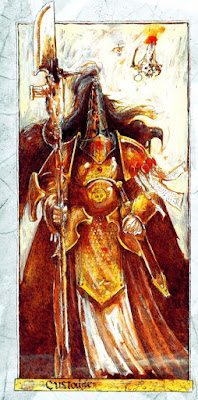
Custiden (2004)

Edlar Pirate (2004)

Slanni (2004)

Awreken Cysst Archchemist of Vyre (2005)

Daemonettes (2005)

Tzeench Chaos Thug (2005)

Plague Marines (2007)

Adeptus Mechanicus (2008)

Grey Knights Fortress (2010)

The trend of the '00s continues even into the '10s, with even more weight - something we will see in next post.

lunedì 10 febbraio 2020

Warhammer Lore - Mankind and Chaos

Ian Miller - The Marcher Fortress (1988)
I've been recently reading through the Realm of Chaos books and they are truly incredible: not just for the wonderful artwork, but also for the atmospheric writing. It FEELS like Warhammer, doesn't it? Not a later, diluted, disinfected, retconned shadow of it.

Now, I have noticed one thing that really excites me about how Chaos is described here, and at the same time its lack puts me off in today's GW products. It's always been like this, but I just realized it: the cool thing about the old Chaos is that Man is its main agent in the world.

Ian Miller - The Chaos Knight (2008)
Even in later settings, Mankind can  be corrupted by Chaos, but in Oldhammer Mankind is the first and most important vehicle for the spread of Chaos. Not only the fears of Mankind feed the stuff the Warp is made of, but their actions also create fertile ground for the Ruinous Powers to root and conquer.

That's right - screw you Chaos Warriors! Go away, Beastmen, and eat your heart out, Skaven! Without Mankind, Chaos wouldn't be sure to conquer the Warhammer World. Man is dooming this world, dooming itself and all other races too.

Tony Ackland - Beastmen (1988)
It is Man who fights back the elder races, plunders the cities of Lustria, raids the Elven shores and even burns his own brethren's villages. It is Man who, consciously or not, follows and fulfills the plans of the Chaos Gods: in fact, the tragic doom of many heroes is to attempt to set their own path while being in fact mere pawns, manipulated by the Powers of the Warp.  Skaven live in fear of Man, buried like parasites under his cities, and Orcs are pushed into remote areas by the might of Mankind's armies. No one can stand against Men, except other Men of course!

I love how Man originally was central in the development of Chaos, and it is sad to see how much Mankind became irrelevant, first in Latehammer, and then in Age of Sigmar: Man there is bland, weak, surpassed: nowadays even the Champions of Mankind aren't human anymore, they are now Sigmarines, the "Stormcast Eternal" forged with the souls of heroes and bodies of sigmarite (sic!) to be larger than life. And that's precisely why Latehammer and Aos are unrelatable and boring settings.

Tony Ackland - Daemonologist (198?)
So give us some nice barbarians, some hunters, some militiamen to fight our battles! Give us daemonologists, mutants and corrupted knights as villains! Bring back humanity to Warhammer! Are you listening, GW?

Do you guys agree? No? Let me know in the comments!

domenica 5 gennaio 2020

Jurgen the Wolf - GW Middenheimer Youngblood (1999)


I am a fan of '80s miniatures because of nostalgia, but in terms of proportions and style my favourite period are the '90s. At this time better tools and materials coupled with talented artists to generate great sculpts. Sadly, the passage to graphic design and finecast has, to some degree, exaggerated some cartoonish features and taken out the soul that hand-sculpted pieces were so full of.


Mordheim miniatures lack all reference to the great age of Oldhammer but they have a character of their own and this is one of my favourites: one of the two Middenheimer Youngbloods sold in a the blister since November 1999. The fact that it is sculpted by the great Alan Perry is a brand of guarantee.


Our youngblood has a dynamic pose, caught in a dash - either charging or running away from an enemy - and his expression conveys all the excitement and urgency of an imminent fight. He is armed with a nothing but a warhammer and dressed in old farmer's clothes (notice the rip on the knee), carries a large bag and a big wolf's hide on his shoulders. Can't get more Middenlander than this! he also carries a bow and a quiver on his side, because he's a hunter.


I don't play Middenheimers, but this will be a nice addition to the Coldwood Smugglers, in the charachter of Jurgen the Wolf. Young Jurgen is from the village of Isenbüttel, the son of a woodsman; when caught poaching to feed his large family, he escaped the Grand Duchy of Middenland. He met the Smugglers in the Coldwood and readily accepted to join them.

venerdì 27 dicembre 2019

Bretonnian Infantry Command, painted as Standard Bearer of Dralas

I got this nice little miniature on eBay. Could not recognize the code, and didn't record the year before basing it. I just know it's Bretonnian and it comes from a command group. It could easily be Perry-sculpted, as far as I know.


I bought him together with a bunch of other Bretonnian infantrymen, with the idea of creating a group of guards to use in WFRP games. I toyed with the project of painting them all with the colours of Dralas, the homebrew city in the Border Princes where most of my scenarios start. After a long time, only this guy has been painted, and the other will most likely follow in another livery, that of Artesia, the bordering princedoms that usually poses as the villain of the campaign.


Dralas is a port city and its colours are white and blue, like the sea and the foam over the waves. The city sits at the mouth of the river Zaffirio, so sapphire is the stone associated with the city heraldry. The other association is the Sea Serpent: according to legend, Dralas was originally founded by Elves and abandoned in the distant past, then a Sea Serpent set its abode under the murky waters of the ruined elven harbour, until the hero Dalphis slew the reptile and reclaimed the ruins, becoming the founder of the city.


Dalphis lived some 15 centuries ago and since then Dralas has seen many events: the city was a capital and then a subject, it had kings, princes and councils of citizens. Until recently it was ruled by a prince, until he was forced by an elven adventurer and pirate to surrender power and the hand of his sister. Nowadays it is the Regent Gelmir Lindarian who controls the government. This, however, does hardly mean that he holds power: Dralas is a famously seedy port where a lot of deals are made under locked doors, and the real power rarely resides where it appears to be.


The Regent directly controls the Black Guard, a group 30 of mercenaries who helped him conquer the city, commanded by general Achille. The Palace Guard's loyalty is divided between the Regent and the Prince: they are about 30 well trained warriors. The City Guard (90 members) follows the orders of the Regent as long as it gets paid regularly. The City Militia, being the largest force in town (450 members), obeys its Captains, who in turn are nominated among nobles, and so they follow their own interests and are generally raised only in case of foreign invasions.


This guy probably belongs to the City Guard and is therefore the most flexible. He could be used to police the streets, guard locations or escort important people in town. He wears a padded leather jacket and a helm, and is armed with a sword (so he is probably an official) and carries a standard with the city device.

martedì 17 dicembre 2019

Fantasy Visuals: John Blanche - Part II (the '90s)

Continues from Part I.

In 1991 Bryan Ansell sold his shares in Games Workshop and left the company, and Tom Kirby took over the top management. More interested in the business side than in art and games, Kirby delegated the supervision of these activities to other managers. John Blanche was already Art Director but he was mostly involved in the Warhammer 40K setting, launched in 1987 and quickly gathering fans; but for Warhammer Fantasy, at that time the core business of the company, work had been directed by Ansell with the assistance of many designers and artists. With Ansell missing, Blanche was able to give a stronger personal touch to Fantasy art.

Unfortunately, in the following years many of the earlier artists that had helped define Warhammer left the company: first Paul Bonner and Adrian Smith started to work on other projects, including comics magazine Toxic! managed by Pat Mills; Russ Nicholson and Ian Miller didn't like the way things were managed and soon left as well, and Tony Ackland also reduced his contributions. eventually John Blanche, Dave Gallagher and Wayne England were the only artists left from the '80s team, and England left not long after. The only new addition to the team was Mark Gibbons.

At this time, Games Workshop was starting to become massively popular, and instead of adapting its products to existing settings - like the world of Tolkien, Moorcock, Lovecraft and Judge Dredd - the company found itself as the plagiarized one. In order to defend its business, GW embarked on a policy that changed its history forever: drop all references from other settings and develop their own lore and style, setting it apart from everyone else to better defend it from copycats. It was the birth of the Warhammer IP.

Cover for WH40K 2nd edition (1993)
While in the '80s Warhammer had thrived on the variety of styles on many artists, now the management wanted to have a single, clear style, which John Blanche was tasked to develop. He had to define, in his words, "the visual language of Warhammer". And the grammar of that language was made of skulls, scrolls, giant banners, bulky armours, fancy helms, oversized weapons, mohawks, masks, tattooed latin mottoes, grotesque shapes, mixing of organic and mechanical, leather, bolts and spikes. 
 
Empire Army (1992)


High Elf Hero (1993)

High Elves (1993)

Undead Army (1994)
Bretonnia (1996)
Night Goblins (1996)

Chaos Thugs (1998)
In Warhammer Fantasy, Blanche's touch was, in a way, more limited but also created a more marked break with the past. The realistic and somehow creepy or melancholic touch of previous authors was lost in favour of pure fury and rage: most of Blanche's art on this setting consists of massive battle scenes, where heroic characters fight in messy melees. It emphasizes combat over subtlety, and epicness over horror. Honestly I don't know if this was intentional or simply a reflection of Blanche's more superficial interest in Fantasy: but the departure from the 80s was significant, and it influenced the whole studio.

Skaven Shaman (1992)

Orc (1995)
To be fair, Blanche also worked on some single character studies, but again they were mostly focused on combat, with monsters wielding weapons and keeping aggressive stances. The new mood was set, and Warhammer Fantasy art would never again be the same.

In Warhammer 40K, Blanche's passion was more evident: he produced marvellous concept art that defined the setting forever. Its sheer breadth and variety is unbelievable, and possibly Blanche reached the zenith of his creativity in this period. Compared to the 80s, his style developed into more sketchy and focusing on surrealistic elements, that distort proportions and convey a feeling of grotesqueness and madeness that eventually became a trademark of 40K.

And they shall know no fear (1993(

Golden Throne (1993)
Squats (1993)
Cupids from Necromunda (1995)
 
Ratskin Ganger from Necromunda (1995)

Adepta Sororitas (1997)
Ecclesiarchy (1997)

Cover for WH40K 3rd edition (1998)
Battlefleet Gothic (1999)
By the end of the '90s, both Warhammer Fantasy and 40K bore the mark of John Blanche. One, in my opinion, more successfully than the other. The following decades would see each develop according to the groudnwork done in the '90s.

And for what concerns John Blanche, everything is detailed in Part III.