Although I am a big Middle-earth fan, my primary interest these days is the historical period often called Post-Carolingian (roughly from the end of the imperial Carolingian dynasty in 887 to the beginning of the imperial Ottonian one in 962). This is a particularly dark period for Europe, but also a crucial one because it's the time Saracens and Magyars get repelled from the South and East; the time when Normans start to mix with other Europeans and absorb their civilisation; it's the time the old nations of Romans, Franks, Lombards, Saxon etc. start to lose their identity, and the new nations of Italians (Italici), French (Francisci) and Germans (Teutisci), based on language, arise.
These below are the first 15mm miniatures I got, with a sample order to Baueda. It was my first attempt to build a Post-Carolingian armed band. I was, and I am, very happy with them.
Baueda is a company based in Vedano Olona (Varese), at the feet of the Italian Alps. It does a lot of products, specializing in tabletop accessories such as camps, fortifications, buildings, etc. They also produce a wide range of miniatures. In the 15mm scale they have a pretty interesting offer.
Now, prices are all right and although delivery is not cheap (EUR 12.5 flat rate, but hey what can we do with Italian mail service?), it works pretty well. I got my order in just a couple of days - granted, the shipping place is about 50km to the delivery place, but still. Service was fast, efficient and extremely friendly.
Here's a picture of what I got:
Now, although the order was just a sampling, the idea behind it was to recreate a force of Italic Kingdom under the reign of king Berengar I (888-924 AD), and the miniatures have been painted accordingly.
The quality of figures is extremely good: the scale is 15mm foot-to-eye, so that they may vary in size, if they crouch or wear a tall helm. The sculptor is Marco Campagna, who achieved a pleasant balance between realism and stylization, meaning that the figures look realistic enough but they are still very nice to paint in detail.
Now, let's have a look in detail at some of the products:
CRL0
The "Charlemagne command" was chosen to represent king Berengar and his herald. The pack also contains the two characters dismounted, which is quite useful if you plan Skirmish Games where a horseman can be dismounted and still continue to fight. The figures are very, very nice as you can see, and the detail is deep and historically accurate.
CRL4
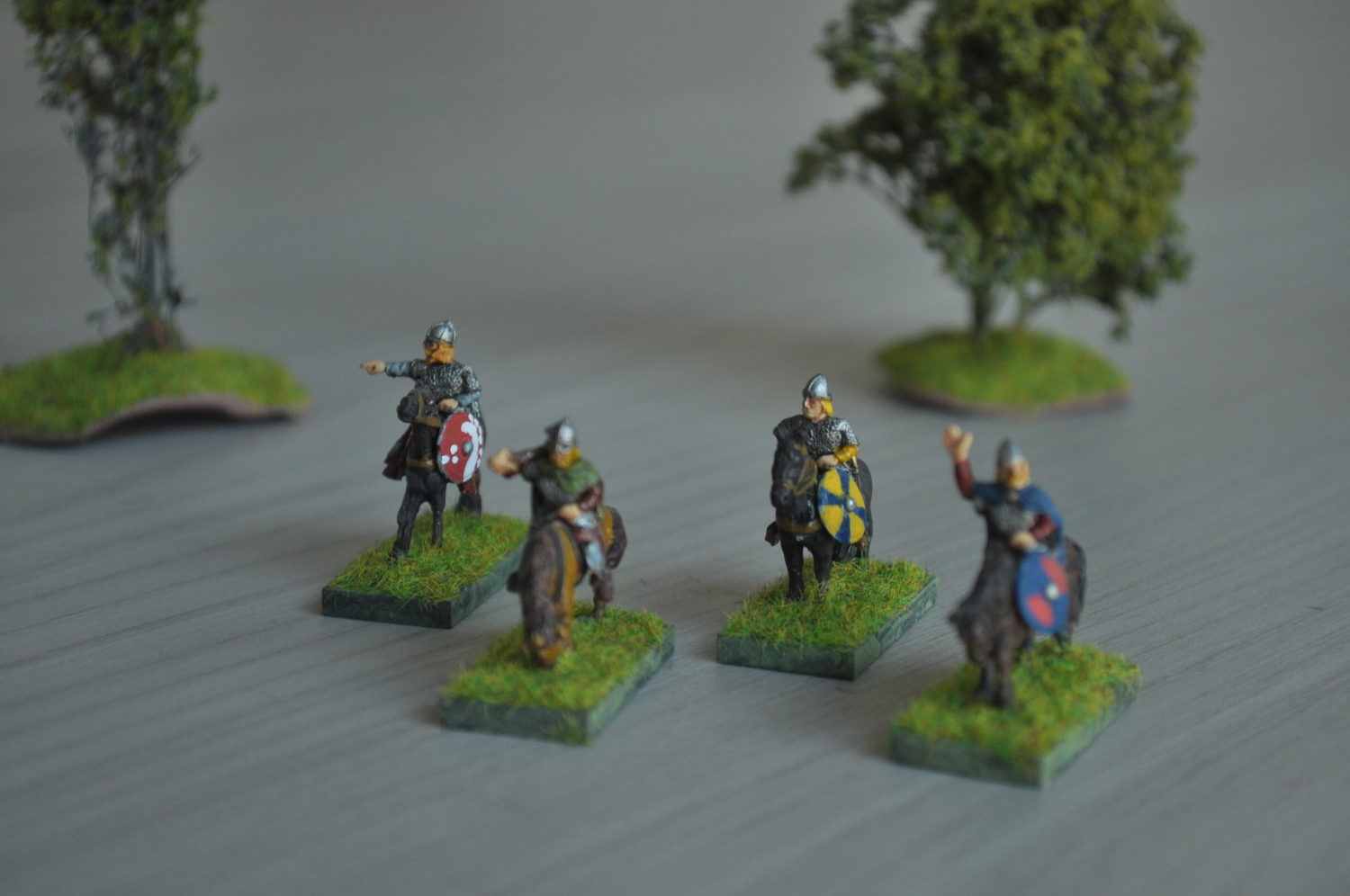
The "Swabian, Bavarian or Thuringian caballarii" can represent basicly any post-Carolingian heavy cavalry armed with sword and shield. I painted with the same colour pattern to represent them as high level retainers who received their weapons from a common Lord. As you can see, 3 different figures in one pack, and again amazing detail.
CRL5
The "Frankish heavy horse archers" represent heavy cavalry armed with bows. 2 poses in a pack of 4 pictures, still good and good detail. Again, I used the same colour pattern as if they are the personal guard of a Lord.
CRL6
But what about the little guys on foot? Here are the "Carolingian Archers", or any archers drawn from the rural, working population in western Europe at that time. 8 figures and 4 poses is quite good, and I also like the detail. The archers were painted all differently to represent the fact that they are a militia with no regular equipment. Colours are quite garish as I wanted my archers to be prosperous massari (peasants) proudly defending their lands (well, their liege's lands!) from the enemy, and not the muddy, poor kind waiting for the first chance to run away from the fight.
LNG5
"Lombard Mounted Followers" are perfect to represent middle-class milites (warriors), who own enough land to equip themselves for war with sword, shield, spear and, most importantly, a horse, but not rich enough to own an armour (which was quite expensive at the time). They were painted in different patterns to represent the origin of their equipment. Here we have 3 poses on 4 figures, and the detail! I especially love the guy on the right and his beard and hair.
LNG6
"Lombard Foot Command": again great detail, and many poses (3 different ones on 8 figures per pack). Here I used them to represent middle and high level milites who will lead the battle groups. In Carolingian and post-Carolingian Italy, the higher milites were often of Frankish, Burgundian, Bavarian or Alemannian origin, while the middle and small milites were typically local Lombards (with a few Ostrogothic elements). Peasants were mostly "Romanic", that is descended from the pre-barbarian population: a mix of Celtic, Etruscan and central Italic blood.
LNG8
The "Lombard Urban Militia" is perfect to be used in post-Carolingian times. This heterogeneous group represents a force of Freemen, most probably craftsmen (smiths, taylors, carpenters) or bureaucrats (small judges or scabini, inspectors, secretaries and messengers). They bring a shield, a sword and a spear, but they aren't rich enough to ride a proper horse. Here we have 4 poses on 8 figures, and nice detail.
LNG10
Provided Freemen were only bound to serve in the army in times of defensive war, in those occasions they weren't only drawn from the city-dwellers. A lot of them actually dwelled in the countryside, remnants of the old Lombard farae who now lived by tilling the land or herding pigs in the woods. They were poor, but they were still free. Most importantly, they were pretty bad-ass, and they went to war armed only with axes and crude swords, and round, coloured shields with the colours of their lineage. The "Lombard warband" was perfect to represent them: here quality is not as high as with other products, and I guess these were sculpted earlier than most. Still, there are 4 poses on 8 figures, and their crudity matches well the characters they represent.
So, in the end two thumbs up for Baueda! I'm gonna get more miniatures from them and expand this army.
Did some of you try this range too? Leave a comment, and let me know.