lunedì 19 ottobre 2020

Fantasy Visuals: John Blanche - Part III (the '00s)

Follows from Part II.

While the '80s were an age of experimentation and the '90s a time of development of a visual language for a new setting, the following decade saw John Blanche sit back and let the other artists of GW proceed along the route he set.

A turning point of Blanche's influence on Fantasy is probably Mordheim, published in 1999. This is the moment when the Old World stops being anything else than Blanchitsu. It's medieval fantasy Necromunda, on steroids. It has all the elements: deformity, madness, skulls, spikes, scrolls used as garments and oversized weapons. In one word, Grimdark.


After Mordheim the way is finally paved and Warhammer Fantasy's frames are drawn. Not that there isn't space for creativity within the studio, but it is limited, and mostly concentrated in the fields that aren't Blanche's direct interest, namely the forces of good like High and Wood Elves, Bretonnians and Dwarfs. Yet even on those Blanche manages to leave his mark, in the form of ridulously large and elaborate helms and headdresses, elaborate clothing that is either form-fitting or oversized, frequently both on the same figure and, of course, skulls.

WFB 6th edition (2000) has only two tables from Blanche, and there's no contribution of his at all for the Army Books, except for a few small sketches. It is clear that Blanche's interest lies elsewhere and, once the necessary job is done, he returns to work on the things that truly inspire him.


It is in this period that Blanche starts adopting a typical format for his works: single characters concepts, full figure, no background, made on small size sheets (A4 or smaller), in pencils/ink and with occasional watercolour/acrylic ink. Inquisitor (2001) is the perfect example (if you think these look way better than those of Fantasy, you are right but we'll discuss this later).


Completely gone are the large colour paintings of the past, and when colour is used the palette is extremely limited to the main colours brown/vermilion/yellow/off white.

WFB 7th edition (2006) is another perfect example of the new approach: Blanche does not draw any large table for it, but contributes with his sketches, and places a particular care on "evil" factions such as Beastmen, Skaven, Undead and Daemons. He does revisit the old art in his own style, occasionally introducing some new designs and elements, and this becomes the model for all GW's art. It is the triumph of Blanchitsu, elevated to "official" standard, a conscious departure from classic Fantasy tropes to make GW's product unique, but also the death of all other styles that made Warhammer so diverse and interesting.


Rurkhar Festigor, Pleaguebeast of Nurgle (2003)
Don Quixote (2005)

Marauders of the North (2005)

Wood Elf (2005)

Beast of Chaos (2007)

Khorne Juggernaut (2007)

Lord of Change (2007)

Vampire (2008)

Zombie Dragon (2008)

Mounted Skaven (2009)

Skavenblight (2009)

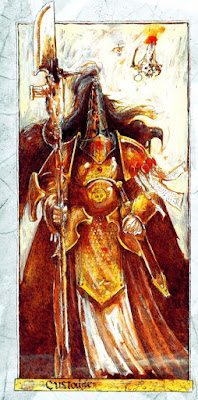
Blanche dedicates many beautiful sketches to Warhammer 40K 5th edition (2008). This is his true barinchild, where he definitely shines without obscuring any other stars. Compare the following works with those before and you see where the passion lies. There is, however, the subtle feeling of a conflict within Games Workshop: whereas Marketing and Sales push the models, Blanche seems more interested in doing his own thing, namely focusing on grotesque characters that really define the feeling of 40K but seem to be unmarketable for an army: almost all of Blanche's most beautiful works are not existing models, and are not used to make new ones.

Arch Deaconne (2004)

Custiden (2004)

Edlar Pirate (2004)

Slanni (2004)

Awreken Cysst Archchemist of Vyre (2005)

Daemonettes (2005)

Tzeench Chaos Thug (2005)

Plague Marines (2007)

Adeptus Mechanicus (2008)

Grey Knights Fortress (2010)

The trend of the '00s continues even into the '10s, with even more weight - something we will see in next post.

martedì 29 settembre 2020

Recycling AoS - The Avenger, Minor Daemon of Solkan


I like Age of Sigmar miniatures - they have great detail and dynamism. The problem is that the setting is silly, and many of them are very invested in the setting. But they can be recycled, if you know what I mean: purged of the silliest, pretentious and late-Blanchesque, to become quite decent pieces to use in your Warhammer games.

Enter the Stormcast Eternal from Warhammer Quest: Silver Tower. It's a Sigmarine, and I don't need to add anything. It's too large to be human, but it could be a golem, or a daemon, or both. A daemon-animated golem. Of Law, of course. Made of unyielding metal and wielding righteous fire as a weapon. Purging Chaos from the world, just as we purge the spirit of AoS from our miniatures.

So here it is, a first and bad attempt at Object Source Lighting - a double OSL because we are overly ambitious and inevitably fuck up. But that's part of the fun.

mercoledì 23 settembre 2020

Ser Pippin the Short of House Boldbuck - Grenadier Halfling Paladin (1992)


Ah, finally! This is a special one. You must know back in 1992, when I was a young boy who just discovered Fantasy books and role-playing games, I took a bus to the city centre to the famous shop Pergioco, a marvellous tresure cave hidden in a secret corner of a back alley - that is to say, a tiny shop with a stair leading to an underground room full of games-related wonders. I was looking for a miniature to represent my MERP PCs, a Sinda Elf warrior, and eventually that day I bought my first miniature. But while rummaging through blisters I was thunderstruck by a single figure, and it was love at first sight. It was a Grenadier blister showing a hobbit in full armour, prancing on a pony and pointing his sword ready to charge. I can't describe the sense of wonder at the time. I wanted it, but I didn't have enough money for two miniatures, and eventually I didn't buy it, and when I came back some time later it was gone. Good-bye, Hobbit paladin (that was the name I have him). Will I ever see you again? 
 

The miniature was a lovely sculpt from that same year 1992, made by Mark Copplestone, initially as part of the Grenadier 1440 Halfling Heroes, and later issued in a single blister. The tab reads "Fluffy Bunny, A875" but the number doesn't match with the Grenadier catalogue.

What happened to Grenadier is history. Apparently the moulds were bought by their Italian distributor Stratelibri but then sold again, after the untimely passing of its owner and manager Giovanni Ingellis, to Mirliton S.G. And it is on their website that I found again my long-lost teenage crush, now renamed as "Halfman Paladin".

There are many things that appear great to our eyes when we are still innocent, but later reveal themselves as something else, just a disappointment. After all, expectations are high but the ability to marvel at beauty is not the same as it once was to our old, jaded taste of old-school grognards. This is not one of them. It's just amazing, and I love it. It is a great model, and I am so happy to have it that I'm not even mad that the sword came bent and when I tried to fix it its tip broke off. Never mind, I fixed it with greenstuff, and I'm okay with it. The Hobbit Paladin is mine!

I painted it as I always imagined it, fresh from the reading of the Lord of the Rings - in the black and white colours of Gondor. Because the hyperuranion Hobbit Paladin or Knight can only be Pippin Took, towering over other hobbits in his Citadel Guard winged helm and uniform. The shield should have born the device of a white tree of course, but with the crest being a bunny, I decided to keep the same on the shield - why yes, it's a rabbit or a hare, not a steinbock! I have to keep practicing with my freehand...

And so I give you Paladin Boldbuck, Halfling knight, friend and companion of the Elector of Averland, also known as Ser Pippin the Short, Defender of the Moot! If you are an enemy, turn away, and if you are a friend, join us for dinner at our manor!

sabato 15 agosto 2020

Mithril M511 Rohir warrior with quilted armour and sword (2009)

Too long I have been painting static Mithril miniatures representing book characters or travellers, and I needed a diversion: a proper armed hero that could be used in any tabletop game. I rummaged through my two cartons of unpainted, still blistered Mithril miniatures (my source of shame) to find this: the 2009 Rohir warrior with quilted armour, sword and shield.


Boy, I needed this. The detail isn't extreme - it doesn't reach the glory of 1980s-90s issues - but it's still ok. The pose is also likeable: it certainly has character. It represents well a warrior inciting his companions to fight.


The sculpt is part of the Helm's Deep Part 1 series, called Gamling's Rally. I enjoyed painting it, although if I could go back I would change the red of the tunic (Vallejo Model Color Burnst Cad. Red), which is too glossy for my taste. On the other hand, I'm very happy with the glaze transition of the shield: that's the green I was looking for.

domenica 2 agosto 2020

Mutant Fimir - Citadel C25 Fimir


Through eBay I got this mismatched body and head of a Fimir, the tail missing. It sat for some time in my "to paint" tray until a post from Richard Irvine's blog inspired me to work on it. A mutant Fimir? Well, why not?


There wasn't much to do on mine, actually, just adding a tail. So I had my fun with drill, copper wire and greenstuff, and topped the thing with a spare head from the Citadel Plastic Zombie kit.


And then, of course, I went creative with colours. A purple Fimir? Well if you go to the marshes at dusk or dawn, that's the colour of the sky and water. Here goes the fluff:

Gelsch-dahd was born with an unusual colour and a missing tail, and he was marked as mutant by the Meargh of his clan. Being mutant was an auspicious sign, but being tail-less was also a handicap: so he was taken under the protective wing of Dirach Shuhul, to be his personal guard. When reaching adult age, Shuhul had visions Gelsch-dahd should go on a quest to the lands of the East, beyond the river Lynsk, known as Troll Country. There Gelsch-dahd fought against men and beasts learning might and cunning. Wounded and hanging to his last spark of life, he had a vision of the Daemon-god Fimùl praising him. After a sleep that seemed eternal, Gelsch-dahd awoke, healed from his wounds and changed. A human-like head now lay at the end of a long tail, and this head could see and speak according to Gelsch-dahd's desires. His return to his clan saw him celebrated as champion of the Fimir and he became a leader among the warriors. The Dead Face of the Marsh, he was named, and became the terror of the neighbouring Human settlements.


giovedì 7 maggio 2020

Clan Crayfish Horn-blower and Sentinel - Foundry Sea Elf Command


Following an earlier test mini, I am now starting to paint a unit of Sea Elves from my homebrew Crayfish Clan from Lustria.


The first one is a musician, blowing a horn that could be a conch-shell or the horn from a sea-beast. The original miniature didn't have the sword, that comes from the GW High Elf Hero and Noble set.


The second one is a sentinel, apparently scanning the horizon and protecting his eyes from the bright Lustrian sun, looking for the enemy. Again, the sabre comes from a GW set, IIRC the Empire Militia set. 


This should turn into some nice unit, I reckon, if the Foundry scale doesn't make it awkward when mixing with Oldhammer minis.