lunedì 19 novembre 2018

Bull Slann with Scimitar - Diehard Miniatures Eru-kin (2017)


I'm starting to like these. This is the second Eru-kin I paint and I enjoy it. It's a nice miniature with the right proportions and fun to paint.


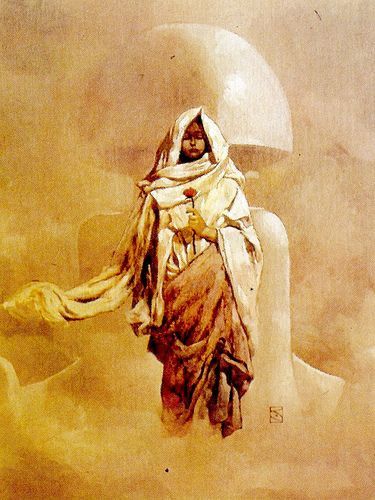
I went for a black and yellow pattern, on a green skin. The shield came out particularly well, and I especially like it since it's a homage to this picture by Paul Bonner - in my opinion, one of the best Slann images ever.


The Menhir

Experimenting with terrain... pretty happy with the first results.


The base is thick, double-layered cardboard, originally the base for a cake. The stone was made with Das clay and then drybrushed in black and greys. The base was sprinkled with sand, drybrushed, and then I glued some static grass.


I need to do another one of this, where I actually engrave some symbols in the stone. I think they'll look good. Also, proportions work well with 15mm scale, but on 25mm it looks small.


GW Zombies (1999)

I've decided to take a very big step in my Warhammerer career, that is to jump from single miniatures to units, and that's because I want not only to use them in my WFRP games, but also try and play some WFB and Mordheim (Age of Sigmar not sure frankly).

I already painted some Goblins and it went good, so now I purchased a box of zombies.


They were an interesting set, quite iconic and recently replicated in the mobile game Mordheim, of which I'm a frequent player. They have a funny look at first, very unrealistic and disproportionate, but overall very Warhammer-y.

However, what I really liked about them is the degree of customization that is possible, something that convicned me to paint each of them separately. This took several months, but it was fun playing with poses and washes to represent blood, bruises and rot. The specimen above is particularly funny, as it's wielding another zombie's leg as a weapon.


With minimum effort, it was possible to add some extra detail like gowns for those zombies that looked more feminine.


This is probably one of my favourites, holding a severed limb in his mouth.


And this one is holding two severed heads, possibly elven.


For the skin, I painted all of them in Zandri Dust, and washed with a selection of colours: Seraphim Sepia for old, dried zombies; Athonian Camo for the younger, still rotting ones; and Reikland Fleshshade for the recently dead, still holding some blood under the skin. I also experimented with Drakenhof Nightshade for a drowned, bluish look. After the first wash I applied plenty of spots of Agrax Earthshade, Carroburg Crimson and Druchii Violet. It was very time consuming but it paid off in terms of dead look.

lunedì 12 novembre 2018

Fantasy Visuals: Jeff Jones


Jeff Jones, sometimes referenced as Jeffrey Catherine Jones, was a US artist that worked in the 1960s and 1970s, doing comics and fantasy art. Although not as famous as other of his contemporaries, he was a greatly talented and respected illustrator.

He was born Jeffrey Durwood Jones in Atlanta, Georgia, on 10th January 1944, the son of a US Army soldier. He spent his youth in Atlanta and then enrolled in Georgia State College: there he met his future wife, Mary Louise Alexander, and the two married in 1966, having a daughter, Julianna, the following year. Jones graduated in that same period, in 1967, as a geologist. His great interest, though, was art and soon he left Georgia with his family and moved to New York City where his talent was immediately recognized: in that same year he was nominated for the Hugo Award to the best fan artist. He started drawing comics and then covers for sci-fi and fantasy books and his career immediately took off. But things were not easy for the family, and in the early 1970s he and his wife divorced.

I wish I was there (1969)

Ceremony (1970)
From 1972 to 1975 the National Lampoon gave him a full page for a strip titled Idyl.


In 1975, Jones joined the Studio, a collective workspace in Manhattan shared with Bernie Wrightson, Barry Windsor-Smith and Michael Kaluta. This was one of the first experiments of shared space for artists, which ensured their independence from corporate constraints, and was soon imitated by many other groups.


In 1979 Jones left the Studio, after publishing a volume with their collective work. In 1980 he received a full page strip in Heavy Metal titled I’m Age. 


Yet at that time Jones was already developing an interest in Expressionism and gradually losing interest in comics.


In 1986 Jones received the World Fantasy Award as best artist.

Since childhood, Jones had not felt comfortable being a man and he secretly wished to be a woman. In 1998 he confronted these issue and started hormone replacement therapy and legally changed his gender, taking the name of Jeffrey Catherine Jones. The transition was not easy and in 2001 Jones suffered a nervous breakdown which brought to the loss of her studio and home. It took three years to recover, but in 2004 she resumed painting and drawing again.

Jones died on 19th May 2011 from severe emphysema and bronchitis.

Jones was a master of styles and during her career she experimented with many of them, notably pencils, ink, oil and watercolours. Reputedly Frank Frazetta called her “the greatest living painter”.


Jones’s style was heavily influenced by Frazetta in subject and form: she was fond of drawing naked bodies of warriors and amazons and great beasts, applying heavy light and shadow and using simple, monochromatic backgrounds. But Jones’s art was somewhat lighter, more playful and positive, especially on his women. He once declared “I am a romantic and a painter and I love women… The female form just reflects light so simply and beautifully,”. 


In her later years, her style veered towards more delicate and personal subjects, especially portraits of women.


venerdì 12 ottobre 2018

WFRP Gamekeeper Art


This post might sound a bit like I'm bragging, so forgive me, but when one is an art geek, few things make him or her more excited that being able to connect two dots together: to fish into the ocean of details learned and committed to memory, and draw an imaginary line to link them, and tie them into something larger and closer to "the whole picture'.

This is what happened to me when I was able to get an original painting of the Gamekeeper WFRP career, by the legendary Tony Ackland, which now sits in my study, just under the Minstrel.


This picture is where everything started - in 1984-85 T. Ackland was commissioned a set of careers for the publishing of WFRP; he drew this among many, and it eventually made it to the final cut (some careers were expunged for space at the last moment).

In 1985 miniatures were also commissioned by GW to the Perry twins, to go with the forthcoming RPG; among them the C07 Ranger series.


In this range, the Gamekeeper appeared as per Ackland's illustration. And below is my copy, painted.

 
This is how the illustration appeared in the WFRP 1ed Core Rules, published in 1986.


This is hardly the only example: it was normal in GW, at the time, to have a direct cooperation between illustrators and sculptors, each influencing each other. Concept art was created all the time and then another artist would elaborate on that, and that is, in my opinion, what made the Golden Age GW so great. Each and every artist was good and had his/her own style, but all were working in harmony under the wise supervision of J. Blanche.
Do you know any other example of  this? Share it! It's awlays nice to dig into the creative process that led to some of the best gaming products ever, which today we simply classify as: Oldhammer.