domenica 26 novembre 2017

Two Mithril Orcs - M308 and M381


Lately, I'm becoming obsessed with skin tones. The last post on the colour of bones is but a declination of such obsession.

Having come in the possession of a couple of unboxed miniatures of Orcs through a private sale, I decided to experiment on them. For years I've wondered about the skin tone of Orcs, which is one of the Great Questions of Fantasy. There will be a post on this, one day, but not today.


So: Mithril Orcs. An archer and a swordsman (swordsorc?). Nice figures. Although they are originally from different ranges, I decide to go for the same colour, and here's my personal recipe.

- Coat grey (Tamiya in my case)
- Basepaint in Steel Legion Drab (Citadel)
- Heavy wash with Agrax Earthshade (Citadel)
- Layer once more with Steel Legion Drab
- Highlight with the same colour mixed with a small quantity of Leather Brown (Vallejo Game Color) or XV-88 (Citadel)

The result was good. I'm not 100% happy with it, but overall not at all unhappy.

Here are the details on each miniature:

M308, Hithaeglir Goblin, The Misty Mountains range  


This was part of a set of two Orcs from 1993, the last code of the Misty Mountains range (M301-308). This specific set included two Orcs armed with swords and shields: the one I bought was missing the shield. Unfortunately I did not check pictures of the original miniature before assembling it: this was supposed to draw his scimitar from the back. The pose I gave him is , in my opinion, more appealing, but it leaves an empty space on the back, where the scimitar ought to be.

All in all, the sculpt is good and dynamic, and it makes a very good game piece.


M381, Morgul Orcs Archer, Rangers of Ithilien range


The Rangers of Ithilien (1996) is by far one of my favourite ranges, and this Orc is indeed a great figure. The plasticity of movement seems to recall the paintings of Frazetta: the tension of the arms, the curved back, the crouched position seem to suggest this Orc was laying in ambush and he just sprang up to shoot at enemies, who appropriately stand below the Orc's position. In other words, this is a sculpt that tells a story, and that's quite an achievement.


lunedì 20 novembre 2017

The Colour of Bones


Bone is a very special material - a material with both organic and mineral composition and a unique texture designed for resistance and lightness. While being indisputably white, bone has a hue of its own, which we will discuss here: bone white.

As this colour is both specific and commonly requested for painters of miniatures, most manufacturers of paints have one in their range, for example Bone White from Game Color (Vallejo) or Citadel Ushabti Bone and Screaming Skull (GW). But judge you not colours by their name.

In fact, the most important thing to know when painting bones, is that bones have no clear colour, and this for three reasons. The first is that the original colour of bones is highly influenced by the mineral composition, which in turn may vary wildly because of diet and environment. As a result, not only different creatures have bones of different colours, but also different people do.

The second element to influence the colour of bones is the situation: freshly scarnificated bones are more yellowish-brown because of the presence of fat, while old bones are whiter. Bones that have been cleaned with a thorough boiling, a practice not only reserved for food but also for important people when - in pre-refrigeration times - they died far from their place of  burial, and the weather was hot and humid. Similarly, bones that have been exposed to extreme heat, like a funeral pyre or dragon breath, tend to be whiter than others.

The third element is the environment to which bones were exposed. Bones buried in the naked ground tend to collect earth and dust into their spongy cavities and cracks, assuming colours that vary from brown to red to yellow. Skeletons abandoned in damp places can be attacked by fungi, moss or algae. Bones exposed to the sun, on the other hand, tend to be bleached by it.

Old bones are just the colour of the earth they were buried in
Bogs preserve bones (and hair) very well even after thousands of years.
Yet mud tends to colour the bone very much
Moss can grow anywhere, including human remains
Skeletons stored in crypts collect dust and soot from candles
Ultimately, the variation of bone colour is so wide that it is impossible to offer a single recipe for painting them: it really depends on how you want them to be.

To exemplify, I tested three recipes on some GW Skeletons.


Here we go - Skeleton No. 1


This model, primed black, was painted with a base of Rakarth Flesh, washed with Agrax Earthshade and then layered first in Rakarth Flesh and then in Pallid Wych Flesh. The result is a very cold figure, an old skeleton illuminated by the light of the moon.

Skeleton No. 2


Warmer tones were obtained with a base of Zandri Dust, washed with Agrax Earthshade and then layered with Zandri Dust, Model Color Dark Sand (but you might as well use Ushabti Bone) and finaly highlighted with Screaming Skull (but you might also use Game Color Bonewhite, which is the same). This is a pretty neutral skeleton which is good for any situation.

Skeleton No. 3


For a yellowish effect, like a skeleton freshly raised from the ground, lighted by torch fire, you can use a base of Zandri Dust and layer it with Model Color Dark Sand. Then wash everything with Seraphim Sepia and layer again with Dark Sand.

 
And here's a back photo to fully appreciate the difference. These are just three possibilities out of hundreds. In the end, anyone can be free to choose a colour scheme of their own liking.

Which one do you like? Let me know your own recipe for skeletons in the comments.

martedì 7 novembre 2017

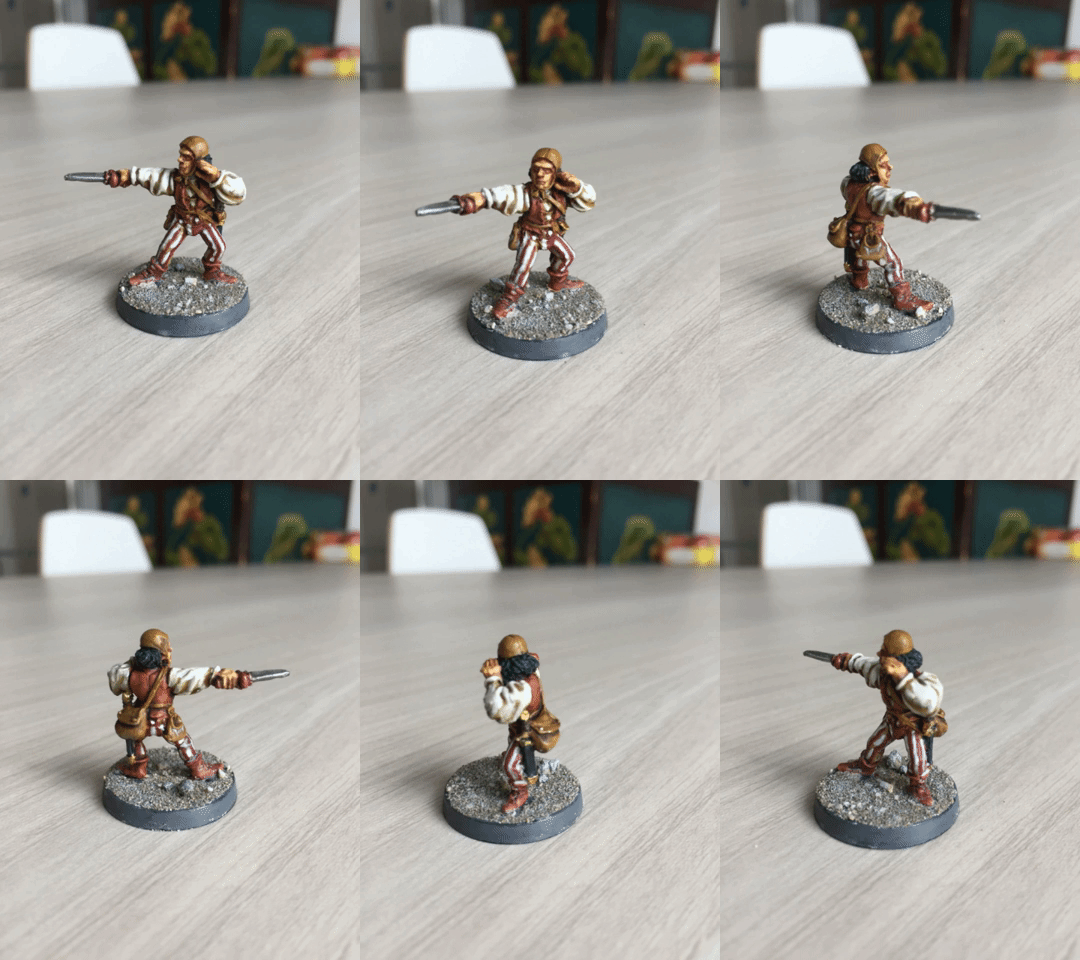
The Mugger - Citadel C05 Thief (1986)


In 1986 Citadel issued a C04 range dedicated to Thieves. The selection of shady characters, all sculpted by the Perry twins, was impressive and drew extensively from the stereotypes of heroic fantasy.


Each of the characters is named, and the one I finished painting this week is recorded as Elshender Nightman, a good fantasy name for a cut-throat. The slotta of the miniature simply records him as "Mugger".


The sculpt, as by the standards of the Perry twins, is nice and full of character and detail. The Mugger is in combat stance, dagger drawn and pointed at the enemy, ready to strike. From his shoulder hangs a large bag, and from the belt another smaller one and a short sword. Clearly an adventuring type, our rogue cares to wear a leather jacket over his shirt, and a coif which could well be made of leather. His pants are tucked into boots more suited for a traveller than a small town criminal.


This is great to represent both a PC and any NPC with a criminal background. This is old school at its best. Love it!

martedì 31 ottobre 2017

Fantasy Visuals: Rodney Matthews

After Roger Dean, the next big name in Fantasy Art in UK was without any doubt Rodney Matthews. Just one year younger than Dean, Matthews was born on 6th July 1945 in Paulton, North Somerset. Like many other authors, he attended an art school (West of England College of Art) and after it he proceeded to find a job in advertising.

It was in 1970 that he decided to leave his job to become a freelance and draw what he liked, but it took some time before he made a name of himself. Using acrylic on board, his primary inspiration at this time were Rackham and the other illustrators of his time, whose influence is clear in the sketchy characters, goblins and elves with slanted eyes and pointed hats, and in the gnarled and twisted shapes of trees. Matthews was, at this time, already a fan of fantasy fiction and Tolkien was his main literary inspiration, so that his first paintings are tributes to the Professor's works. The depth of Matthew's knowledge of Tolkien's books is noteworthy: while the Hobbit and the Lord of Rings were popular with artists, few even knew about the Silmarillion, published in 1977: that same year, our author was already drawing scenes from it.
1973 Gollum in the Dead Marshes

1977 The People of the Pines - a reference to the Elves of Dorthonion
1979 A view over Isengard

The Dwarves of Belegost
Soon, however, Matthews' style developed with two, even greater, influences. The first was the work of Roger Dean, which we already mentioned - one year older, Dean was already very famous and at some point Matthews started to draw heavily from his style, setting his scenes in surrealistic landscapes with atmospheric lights. This didn't suit well Dean, who considered Matthews a shameless plagiarist.
1981 Mirador
1987 Stronghold
1970s Inverted Landscapes
1970s Freyja's ca... no wait, this is "Tanelorn"
True or not (you decide), around this time Matthews started to get commissions for album covers, and soon made a name in the industry, at first working for prog bands (including Asia, Dean's best client) but later becoming iconic for heavy metal ones.
1978 No mean city - Nazareth
1981 Time tells no lies - Praying Mantis
1981 Time to turn - Eloy (UK issue)
1995 Arena - Asia

The other inspiration was a writer, Michael Moorcock, who was just at this time receiving his first recognitions. Matthews and Moorcock became friends and actively cooperated, with the first illustrating the second's stories, especially those about Elric of Melniboné.

Chequered Floor
Obsidian Castle
The Dragon Lord
1981 - Encore at the End of Time
From the 80s on, Rodney Matthews became a well established author doing a lot of works also based on other books, and his style became more stable. He did many book covers, calendars and more albums, plus in the 1990s he opened his own web store where he sells art prints, mugs and other merchandising.

1978 Estcarp Five - Matthews illustrated many covers from the Witch World cycle
The Duke to the Rescue - this is from F. Herbert's Dune
The sack of Zodanga - from E. Rice Burrough's Mars cycle
In 1998 Matthews worked with Gerry Anderson on the children animated series Lavender Castle.


In the same year he worked with Psygnosis supplying conceptual designs for the game Shadow Master and again in 2002 for Haven: Call of the King by Midway.

Still active at the time of this post, Rodney Matthews is a difficult artist to frame. On one side, he borrowed extensively (shamelessly, one would say) from other artists both visually and conceptually (but then, also Led Zeppelin did, didn't they?). On the other, he has created outstanding art whose influence on sci-fi, steampunk and fantasy can not be in any way downplayed.

Talking about influences, Matthews's style could be described as Proto-Hammer: all the early artists at Games Workshop were directly or indirectly referencing his works. You can glimpse it in John Blanche's reddish or yellowish landscapes and crooked tree-shapes, or in Tony Ackland's demons with long, flat, skullish heads and overlong claws; in Jes Goodwin's Elves with pointed hats, long, thin faces and slanted eyes, or again in Gary Chalk's exaggerated traits in Goblins and monsters. Perhaps Warhammer as we know it would not exist without Rodney Matthews.

Think of that! And while you do, take a look at a gallery of my favourites:

1978 - Drum Boogie
1979 - Dragon Colony (from Elric at the End of Time)
Ilian of Garathorm

1985 - The Heavy Metal Hero
1992 - Lament for the Weary

2008 - Immortal

lunedì 23 ottobre 2017

Spiros Kanakis - Steve Barber Greek Irregular No. 1 (2014)


I am a man of many interests. Too many, some might say. I am a huge nerd for 10th century Europe. Then I also dig all things Middle-earth. Warhammer (Oldhammer), too. Recently I even started venturing into Warhammer 40K. All of these had (or will have) some degree of space on this blog. 

The thing you didn't know yet is that I'm also a fan of all things Oriental in the Colonial Age. That wonderful time when Europeans were discovering the world was a bigger place than they thought, and were creating a new one by meeting the great civilisations of the East.
 

I even play an RPG set in 1831 Orient. We started several years ago with the PCs (a young and unscrupulous English gambler, an aging and disenchented Scottish war doctor looking for retirement, an ambitious and manipulative Italian Jesuit priest and an ex Turkish Janissary in hiding) meeting in Istanbul. Through haphazard planning and conning whomever they could, they managed to flee the city for Greece, Rome and then Egypt, where they are currently trying to escape once more a long list of enemies they made along the way. Several of them have died gruesomely and have been replaced by new PCs.


One of these is Spiros Kanakis, Greek merchant, sea captain and adventurer, who met the group in the Hellenic capital of Nauplia and was hired to transport them around the Eastern Mediterranean.

Spiros was naive enough to introduce the other PCs to his friends dealing in politics, high ranking members of the English Party. Soon enough their empty promises and clumsy manipulation forced them to leave and Spiros with them - partly because he does not dare to go back to Nauplia, and partly because he is decided to make as much profit as he can from the other PCs. He is a professional looking for profit but most of the time his efforts are directed at staying alive and not being arrested by the local authorities.

Spiros is currently in Alexandria, trying to book a passage for India, and at the same time trying to rescue the Scottish doctor whom, dressed as a Greek and posing as a Frenchman, was captured by the secret police of the khedivé and accused (quite rightly, I might say) to be a spy.


As far as I know, there is only one company manufacturing models of Greeks during the War of Independence period, and this is Steve Barber Models. They were commissioned to do this range by a generous patron in 2014 and they have, in my opinion, done an excellent job. This figure depicts a Greek or Albanian Irregular, with the traditional clothes of these people during the early 19th century. He is armed with a muzzle-loading rifle, a long straight knife and a curved sabre.

The level of detail is good, and painting it was easy and fun. I look forward to do justice to the rest of the range in the months to come!