giovedì 30 marzo 2017

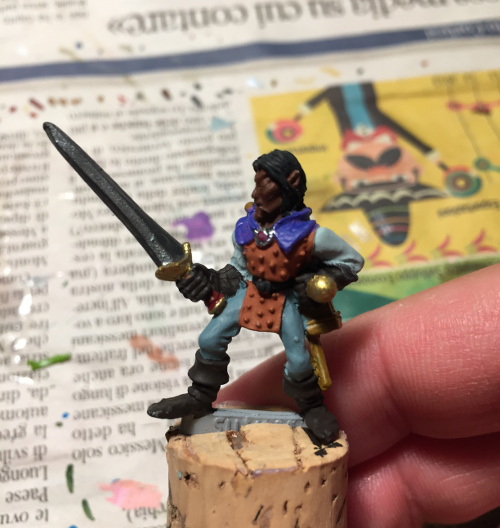
Gelmir the Adventurer - Citadel Silvan Elf ME31 (1985)


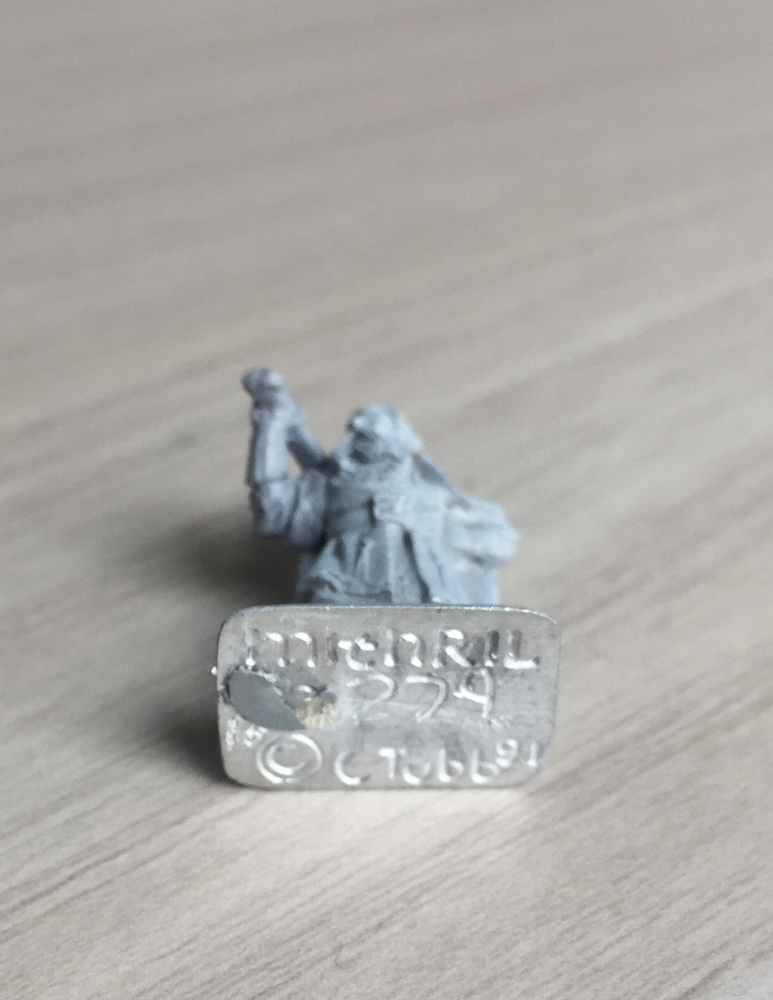
This miniature couples with that of Lamshâr, so there's not much more to say. They look similar indeed, except for the head, and they are Jes Goodwin sculpts released in 1985 as LotR Silvan Elves and, later, in 1989 in the Late Summer Catalogue.


This miniature, though, was painted with the nemesis of Dark Elf Assassin Lamshâr: the Sea Elf Hero Gelmir, my first WFRP PC whose origins were briely touched in this earlier post.


So here goes, very briefly, the first part of the great tale of Gelmir, Harpist of the Gates, Chosen of Quesshan and Regent of Dralas, which covers possibly four intense years of gaming between 1996 and 2000.


Gelmir was the son of poor Sea Elf settlers in the Wasteland, living in the village of Grilm. His father died at sea when he was infant, and the mother was slain by Goblinoids when little Gelmir was but a child, hiding under the bed with his siblings. Survivors of the pillage of Grilm, Gelmir and his siblings made a living as street urchins and beggars in the nearby town of Zeaburg for a few years until one day they were found by another Sea Elf, Elmerin, who brought them to Lothern and adopted them as his own.

Gelmir came back to the Old World when he reached adulthood, on a trip to revisit his past and perhaps find Brandir, his brother who had been lost before Elmerin found them. He travelled to Marienburg and then along the Reik until Nuln, where he found a job as bodyguard of Counsellor Oldenhaller. At this time, together with some companions, he uncovered a net of warpstone smugglers covering a good part of the Empire: this criminal organisation was led by Skaven Champion Boneface. With the help of three mysterious Old Slann spectres, the heroes vanquished the organisation and chased Boneface to Marienburg where they killed him, finding out he was the reincarnation of a fourth Slann spectre. They four undead were in possession of a piece of music which could expand or reduce portals to the Warp: Boneface was bent on expanding the Northern Warpgate with it (reached by a convenient portal), but Gelmir just in time played his harp and brought back the Gate at the original size - no less. This was the first feat of Gelmir as a hero, and one that put him on the list of the servants of Chaos as an enemy, and as the possessor of a piece of the Melody of the Gates. 

Begore disappearing, the four spectres indeed prophesised that one day, not far away, the representatives of the Free Peoples of the World would have the chance to close the Warpgates. This was a key event in Gelmir's life, who believed from that day that he had a destiny to fulfill and save the world, a belief that later, after a number of failed Coolness Tests, developed first into Megalomania and then into Heroic Idiocy.


With his newfound Slann blade Myrmidag, Gelmir left the Old World and travelled to Lustria, looking for someone who could translate some Old Slann books which had been owned by the four spectres. In Lustria he found a friend, the scholar Balgar, but also a lot of enemies. Balgar was kidnapped and brought, ironically, to the Old World, where a group of Malalite Dark Elves were trying to tackle with a Moon Gate, an alternative to Warp Gates. Gelmir chased the kidnappers but could not save his friend. In a fit of rage, Gelmir killed his assassin but also broke his blade, already weakened by thousands of years of exposure to Chaos radiations.

Back went Gelmir to Lustria, carrying the body of Balgar, the untranslated books and the pieces of Myrmidag. Again he found somebody willing to help, but not openly as the Church of the Snake-god Quesshan, the main religious organisation of the Slann, was not kind to foreigners and those who owned artefacts which they considered their own. It was at this time that, frustrated by his inability to find allies, Gelmir defied the laws of the Slann and travelled inland into Lustria, reaching incognito the capital Aztelcahuan: captured and risking death, he managed to pass himself as a pilgrim delivering gifts to the Great Emperor - the Old Slann books. Awed by the precious gift, the courtesans of the Emperor allowed Gelmir an audience with the Lord of the World, where he was kindly blessed and then sent back to the coast, but not without hearing legends about Myrmidag being part of a trio of ancient swords, sacred to Quesshan.

In coastal Lustria, once again Gelmir was attacked by Chaos servants, this time the Champion of Slaanesh Lamshâr who stole the Melody. One again, Gelmir gave chase, helped by other heroes, finding the enemy at Karak Azul. Here, with a portal, they reached the Souther Warpgates and stopped the Dark Elf from becoming a Chaos Prince. 

This trip allowed Gelmir to talk with Dwarfish smiths about the properties of the legendary mithril steel and the reforging of Myrmidag. Gelmir then went looking for the ruins of Boneface's underground lair where he thought he could find more about Old Slann lore, but there he found contemporary Slann, also looking for the same answers! Fighting his way out, Gelmir discovered to be on the enemy list of not only Chaos followers, but also the great Slann archmage Anguissh, who believed the Sea Elf was withholding secret Slann lore and, quite correctly, that he had the pieces of Myrmidag. The wizard was looking forward to collect the three blades of Quesshan because together they would have merged into the Sword of Quesshan, an ultimate weapon destined to be wielded by a Champion of the Slann against Chaos.

Gelmir travelled far and wide the Old World and over to Ulthuan to put together information about the swords and reforge Myrmidag, always chased by minions of Anguissh. Gelmir and Anguissh's champion met in a final showdown in Tilea, where the three swords were finally collected in the same place: ironically, when the three swords merged into the legendary Quesshandag, the sword refused to be wielded by the Slann and instead accepted the grip of Gelmir, who slew all his enemies except for the archmage, who beat a hasty retreat. It was this event that convinced Gelmir even more that he was the Chosen One of Quesshan, that he was the Hero of the Free Peoples against Chaos.

Committed to the prophecy of the Slann spectres, Gelmir made peace with Anguissh and invited him at a Council in Nuln, where all loremasters from the Old World and Ulthuan would gather to discuss a plan to close the Warpgates. Together, these great minds were able to complete a larger part of the Melody and then divided into groups to further study different aspects of the plan.

But a Hero can not fight Chaos alone: he needs an army. And to sustain an army, he needs a kingdom, thought Gelmir. So he started looking for one, in the Border Princes. It took him months of preparations and several failed attempts but, at last, he was able to sneak into the port of Dralas and hold hostage his Prince, obtaining his sister in marriage and the title of Regent.

That was the start of Gelmir's life as a nobleman, and another chapter of his tale...

lunedì 6 marzo 2017

Gelmir the Sea Elf - Citadel Elf Command Musician (1987)

In the beginning, there was the glorious and embarassing original setting of Warhammer Fantasy. It was glorious because it was simply one of the most imaginative and cool settings ever. It was embarassing, because it blatantly stole elements from Tolkien and Moorcock, mixed them with pop culture and sprinkled a good bit of stereotyping on top.

There were Slann, of course. There were Amazons. There were Pygmies. And there were Sea Elves. All things that were happily retconned in the 90s because the creative management at GW thought they veered too much on the embarassing side of the spectrum, no matter how glorious they were.

This is what WFRP 1E had to say about Sea Elves:
The Elves living around the coasts of the Elven Kingdoms have a tradition of seamanship and fighting, and lack the normal Elven disdain of physical labour.  Because of this, the High Elves look down on them, thinking them rough and uncouth.  They are brave warriors and tireless guardians of the seaways, and it is thanks to them that the sea routes between the Old World and Lustria remain open.  Sea Elves are quite venturesome, and can often be found as merchants and traders in old World ports.  Most of them speak Old Worlder as well as Elvish, and many have a smattering of the Norse language too.  The Elven trading posts of the Old World are run almost exclusively by Sea Elves.


In later years, Sea Elves were simply absorbed into the High Elves or, as the Lore, named them, the Asur. A memory of their existence could be traced in the division of High Elves between those belonging to the introspective inner realms of Ulthuan, and those hailing from the hardy and seafaring outer realms.

But in their glory days, the Sea Elves were the Warhammer Sindar, the Falathrim of the Old World, the link between the lands of Men and Ulthuan, Lustria and the rest of the world. They were cosmopolitan, adventurous and interested in trading. Basicly the opposite of the isolationist High Elves, the secretive Wood Elves and the decadent Dark Elves.


No wonder that my first WFRP PC was a Sea Elf then. Gelmir, he was named, son of Handir, born in the miserable harbour of Grilm, on the coasts of the Wasteland, not far from Marienburg. He was an orphan, a bodyguard, quite ugly by elven standards (which still made him the most handsome of the party) and blessed with the boon of having a morality closer to Man than Elf. In other words, he was elvish, good and a lover of beauty and all, but at times a huge son of a b$%£h.


The miniature for this PC is a 1987 Citadel cast for the Elf Command Group (#10, Musician), scuplted by Jes Goodwin. It is a nice figure, with good proportions and very nice hair. It's perfect for an adventurer, with its causal garments and big belt with satchels. I choose it for the harp, which was a key element of Gelmir the Sea Elf - he had learned a melody from some Old Slann ghosts, by virtue of which he could widen or narrow warp portals, and this skill was instrumental more than once in limiting the power of Chaos champions and sorcerers.

Any opinion or memories with Sea Elves? Let me know in the comments!


domenica 19 febbraio 2017

My first miniature - Metal Magic Elf Archer w Cape


It was sometimes between 1993 and 1995, I guess. There was this shop, Pergioco, on the back of piazza Cordusio in Milan. It looked like a tiny shop, but there was a stair leading downwards into a very large room packed with boardgames, role-playing games, miniatures, dice and such. It was Saturday afternoon paradise, for an early teenager like I was.

Not that I had the money to buy anything. The subway tickets to the city centre took away about 40% of my weekly budget. But still, a few months after playing my first session of RPGs, I decided to buy a miniature. It was though deciding which one, but finally the choice fell on this one.

Elf Archers with Cape (1033e, 1992) from Metal Magic, a brand at that time owned by Hobby Products, a German manufacturer. To this day, I consider this one of the finest miniatures ever produced, and one that has shaped my aesthetic taste in fantasy. Truly, Josef Ochmann did a hell of a job on this one.


Take the perfect dynamic pose, for example: this Elf is loading an arrow and is set to shoot at a distant point, aiming slightly upwards to achieve a longer range. He has a distinctive elfin physique, slim but proportionate. Then there are the details: the trimming on the tunic, the fishlike scales of the armour following the shape of the chest, giving the idea of a lightweight armour and not a heavy one falling vertically. The sword on one side and the quiver on the other. High boots and a long cape. This is the hyperuranic elvish adventurer.

This was, for a long time, Haldir, the Sinda warrior from the Grey Havens, whom I played in MERP. Too bad I had no idea how to paint it and no budget to buy the expensive sets for painting at the time.

So I gave it to one of the guys in my playing group, because he claimed he was good. He held it for about 6 months and, after repeated requests to return it, gave it back with the lousiest paintjob ever. It was, quite literally, a clumsy brush of pink on the face and hands, one of grey on the armour, and one of green on the cloak. End of it (WIP, he claimed). But what made me really mad was that I made ONE request: that the cape was to grey. Haldir was a Grey Elf, after all, and having read the Silmarillion quite recently, I was adamant about it.

Years later I found another friend (I had left the old group since, and wasn't playing MERP anymore) who could paint, and graciously offered to paint my miniature. He did what you see now, a very nice paintjob, at least for a teenager from the 90s. We didn't have much money fro colours and brushes, and we didn't have any access to GW's paint courses or youtube tutorials. Everything was perfect, except for one detail: the cape was, again, green.

If you want a job well done, they say, there's only one way to do it. So I did it myself. Meanwhile the GW shop had opened in Milan, I got myself a set of colours, and painted the cloak in grey. And that's how, over the course of several year, this miniature got painted.

What was your first miniature? Any interesting story to share? Let me know in the comments!


domenica 15 gennaio 2017

Berengar Took - Mithril Hobbit Scout on Pony (M60)

It's funny how you start painting a miniature with no idea or inspiration, and you end up with a piece that's not only above your average, but also developed in your hands, way beyond your original intention, and actually came to represent a character with an appealing background story.
 

That's what happened with Mithril Hobbit Scout on Pony (M60), which I started painting in October 2016, and finished in the last days of the year. During its painting I put it down and picked it up again a number of times, choosing to focus some days on other miniatures that were, at the time, more interesting.

The only ideas I had, when I started, was that the hobbit should have dark brown hair and a green cloak. In the end it had a green cloak, indeed. The hair somehow started with a light brown and came up almost blonde.


A blonde hobbit? Why not? Before repainting my mistake, I did some research, and came up with a quote.
Before the crossing of the mountains the Hobbits had already become divided into three somewhat different breeds: Harfoots, Stoors, and Fallohides. The Harfoots were browner of skin, smaller, and shorter, and they were beardless and bootless; their hands and feet were neat and nimble; and they preferred highlands and hillsides. The Stoors were broader, heavier in build; their feet and hands were larger, and they preferred flat lands and riversides. The Fallohides were fairer of skin and also of hair, and they were taller and slimmer than the others; they were lovers of trees and of woodlands.
FotR
Well, Mithril said it's a scout, so... Fallohide it is. Fair-skinned and fair-haired, our hobbit needs a name now.
In some old families, especially those of Fallohide origin such as the Tooks and the Bolgers, it was, however, the custom to give high-sounding first-names. Since most of these seem to have been drawn from legends of the past, of Men as well as of Hobbits, and many while now meaningless to Hobbits closely resembled the names of Men in the Vale of Anduin, or in Dale, or in the Mark, I have turned them into those old names, largely of Frankish and Gothic origin, that are still used by us or are met in our histories. I have thus at any rate preserved the often comic contrast between the first-names and surnames, of which the Hobbits themselves were well aware.
RotK, Appendix F
Took. Everything seems to fall into place, now! I think I'll call him Berengar, just because I'm a big fan of Berengar I of Friuli, king of Italy (888-924) and son of Eberhard the Saint, one of the closest advisors to emperor Louis the Pious.

Berengar Took. The Scout. Or, even better, the Adventurer!
[...] certainly there was still something not entirely hobbit-like about them, - and once in a while members of the Took-clan would go and have adventures. They discreetly disappeared, and the family hushed it up; but the fact remained that the Tooks were not as respectable as the Bagginses, though they were undoubtedly richer.
Hob
I can almost hear Berengar's mum, complaining that all the family loved trees and woodlands, but it was certainly not normal for one of them to go and visit the great forests beyond the Brandywine! 
"Where did all that talk of elves and dragons, and magic rings and shining swords came from?" wondered Berengar's mother.
"I tell you where it came from" muttered his Uncle, Ludovic, while sucking on his pipe "from that ol' Wizard that comes every now and then. He looks all jolly and friendly, but he's up to no good, mark my words!"
"The Wizard?!?" gasped the woman.
Not the fellow who used to tell such wonderful tales at parties, about dragons and goblins and giants and the rescue of princesses and the unexpected luck of widows' sons? [...] Not the Gandalf who was responsible for so many quiet lads and lasses going off into the Blue for mad adventures. Anything from climbing trees to visiting Elves - or sailing in ships, sailing to other shores! 
Hob
Yep, that one.

That Gandalf better stay away from my children!
Anyway. The miniature is lovely, really. One of the best I've seen so far from Mr. Tubb. The date on the base is 1988 and the sculpt belongs to the group "Gandalf and the Shire-folk".


What I really like about this miniature is that it manages to be full of realistic detail and, at the same time, have something magical and poetic.


The drapery of the cloak is just perfect. And the way the hobbit looks around - perhaps scanning the landscape, perhaps marvelling at it - is just glorious. Also the pony is finely sculpted, with the right proportions and a strolling pose matching the relaxed position of the rider. 


The baggage is very well done, and so is the short sword hanging from the side.


And did I mention the drapery of the cloak, yet? No, this is probably one of my favourite Mithril miniatures so far. Ride, Berengar, follow the Road to wherever it goes!
           Farewell we call to hearth and hall!
           Though wind may blow and rain may fall,
           We must away ere break of day
           Far over wood and mountain tall.

           To Rivendell, where Elves yet dwell
           In glades beneath the misty fell,
           Through moor and waste we ride in haste,
           And whither then we cannot tell.

           With foes ahead, behind us dread,
           Beneath the sky shall be our bed,
           Until at last our toil be passed,
           Our journey done, our errand sped.

           We must away! We must away!
           We ride before the break of day!


venerdì 6 gennaio 2017

Lamshâr - Citadel Silvan Elf ME31 (1985)

I got on eBay this cool Jess Goodwin sculpt from 1985, which was sold by Citadel as Silvan Elf ME31. Interestingly, the same figure was later included in the 1989 Citadel Late Summer Catalogue (item 074213/2) as Wood Elf Champion. I bought it without a clear idea of what to do with it and then, on a whim, last month I decided to paint like one of the main NPCs, and by far one of the best villains, of my WFRP campaign.
The miniature was missing the original shield and I had to make do with a different one - full shield, to which I added a hole with a hot screw, and by sheer luck it fit perfectly.


So I give you Lamshâr, Dark Elf Assassin and Champion of Slaanesh.

The PCs met Lamshâr for the first time in Karak Azûl, a Dwarfish hold at that time overrun by Goblinoids. Driven by a dream to explore the Lower Depths, they discovered the Goblins were under the rule of a Greater Daemon, Urmarcht. He, in turn, had been appointed by the Dark Powers to recover the Melody of the Gates, a piece of Slann music that could be used to open or close portals on the Warp. Said Melody (or a part of it, but that was not known to the PCs yet) was in the possession of a Sea Elf, Gelmir of Lothern, currently lodging in the great city of Quezzhar on the coast of Lustria. And Urmarcht, having a Goblinoid kingdom to rule, appointed in turn his right-hand man, the Dark Elf Assassin Lamshâr.


Now, Lamshâr was not a standard Dark Elf: for one, he was really dark - a Gift of Slaanesh, which made his skin as smooth and dark as ebony. Graced with unnatural charm and grace, he had a signature mocking smile which made women faint from lust and men seeth from offence. And indeed that's what happened, with the Wood Elf Knight Errant girl falling almost immediately for him, and the Dwarf Judicial Champion vowing to heave his head with his axe. He got a scar in the attempt, and she got a night of unspeakable pleasures, while the other PCs were asleep and he broke into her room at a local inn.


But I am hasting too much - off sets Lamshâr from Karak Azûl to Barak Varr, where he boards a ship directed to Ulthuan first and Quezzhar later. The PCs follow as they can, but he is always a step ahead of them. That includes finding Gelmir of Lothern almost dead and deprived of the papers where he recorded the Melody. In Lustria, they almost catch up with Lamshâr - almost meaning getting a scar or a night of decadent lovemaking. But by sunrise the Assassin has already boarded a ship back to the Old World.


The PCs try again to follow, on the Grey Wave, Gelmir's ship. They are slower than other Elvish frigates, but they can cut the stopover in Ulthuan and head directly to Barak Varr, in the hope that they can set a trap for Lamshâr there. But he's smarter than them, as usual, and avoids it, so he can reach Karak Azûl days ahead of them. Always a step ahead, but never really taking action against them. It's as if he enjoyed toying with them, rather than eliminating their threat once and for all. Or is he?

It is in Karak Azûl that the PCs finally confronted the Daemon Urmarcht, now in possession of the Melody, and uncovered his plan to enlarge the Southern Gate of Chaos to absorb its energy and become a Prince of Chaos, with the blessing of the Ruinous Powers. And they stopped it - with the help of Kar Knuurg, the legendary War Axe of the Kings of Karak Azûl, they fell the monster after an epic battle in the Lower Depths.


 It was then that Lamshâr, suspiciously absent until that time, reappeared. Just as Urmarcht was uttering a final curse on the PCs, the Assassin pierced his neck with a blade.

"I must thank you" he bowed mockingly to the PCs "I would have never achieved that by myself. With your help, though... but let me show my gratitude by allowing you to witness my own rise as a Prince of Chaos. Please, follow me, if you can!"

With that the Dark Elf started to run and jumped into a portal, with the PCs following suit. They could only look, while the Assassin, faster than them, played with his flute the Melody and enlarged the titanic vortex suspended in the stormy sky, over a living wasteland of limbs, tentacles and screaming mouths: the Southern Gate of Chaos. As the Eye in the Sky expanded, Lamshâr was pulled into it by an invisible force. And, moments after disappearing in the maelstrom of impossible colours, something started coming out of the Gate.


A colossal monster, whose head was half skull and half Lamshâr, barbed with six convoluted horns, slowly emerged from the Hole, as if it was climbing out from a blasphemous womb. Triumphant, he screamed with a thousand voices his victory. But just then, Gelmir started playing with his harp the same Melody - only backwards.


The Gate started to recede, slowly but steadily, and the Beast screamed again, but this time with fear and frustration. The Gate shrunk, cutting off his body in half. Iridescent blood, or whatever it was, fell on the living plain which fed itself off the ichor. With a fearsome groan, the Chaos Spawn that was to be a Prince of Chaos died, and its gigantic body sank into the teeming ground, gnarled and gnawed by invisible teeth. The Melody was over, at least the bit which Gelmir knew. The Gate was not closed, but it has receded to the same size as before. It was time to go, before the portal closed itself.

That was the end of Lamshâr, Dark Elf Assassin, Champion of Slaanesh and would-be Prince of Chaos.


Lamshâr's main weapons were a whip and a repeating crossbow - alas, difficult to find in miniatures, except heavily armoured Dark Elves. But a bow and a long sword will do, along with a nice shield painted with the wheel of Chaos.

domenica 11 dicembre 2016

Mithril MC3 Thorin Oakenshield


This is one of the Classic series by Mithril, issued in the early 1990s. They represent key characters in the original stories of Tolkien, and namely the Hobbit and the Lord of the Rings.

In this specific sculpt, Chris Tubb represented Thorin in fine clothes and holding on his shoulder the sword Orcrist. We may suppose this was meant to either represent Thorin during his stop at Rivendell, shortly after he recovered the sword from Hill Trolls in Rhudaur, or in Esgaroth, while he was a guest of the Master. The sculpt dates from 1991, as indicated on the base.


Thorin looks particularly relaxed and lordly, in line with the description of the Hobbit, where he is described as "an enormously important dwarf" and "very haughty". He drinks wine, plays a silver harp, does not help clean the table and holds a very long and institutional speech. I must say I really love how Tubb used he pose of the figure to bring out its character.

Now, allow me this short rant: Thorin's main characteristic is to be haughty. He is, after all, a very noble Dwarf, perhaps the noblest living in Middle-earth and Arda. He is heir of the kings of the Longbeards, the direct descendant of Durin the Deathless. He is pompous, sometimes arrogant, in a way obsessed with his inheritance and his family duty. But he is also a good leader, generous with his men, beloved by his people; he's smart, very good in talking his way out of situations, and yet keep his honour by not telling any lie; he can be aggressive, but he can be fun, too, laughing and singing with the other dwarves. He is just not simply a self-centered, brooding dick, as portrayed in the movies. I really hated how he came out there. Really, Thorin is such a great and complex character, PJ didn't do him justice. But then again, he didn't do justice to any character in the story, especially the grey-shaded ones.
Right, end of the rant.

It took me some time to decide how to paint it. The reasoning was that at Rivendell and Lake-town Thorin probably wore clothes that were fine but still not excessively rich: he was travelling after all. They should display deep colours, but not too garish. The only set thing was the hood: in the Hobbit, Thorin wears a "detachable hood" which was "sky-blue [...] with a long silver tassel". Now, this miniatures displays a cloak, not a detachable hood, but still here is the long silver tassel attached to the hood. I decided to go with it and keep the colours of sky-blue and silver.


The first layer of painting left me unhappy with the gold-rimmed cloak. That seemed too much for travelling clothes, so I changed that to silver as well.


Yes! I'm very happy with how the cloak turned out. Still room for improvement, but definitely better than the last one. The sword also looks nice - I painted it silver with a dark blue scabbard, to retain some "elvish flavour". I decided to leave the base pretty much disadorned, except for a dark green base and some lighter drybrush. This miniature will probably be used in games, so I don't want to add staff that will come off with heavy handling.

Look at the famous Thorin, son of Thráin, son of Thrór, heir of the Folk of Durin, gloating at the prospects of his homecoming to Erebor:
The King beneath the mountains,
The King of carven stone,
The lord of silver fountains
Shall come into his own!

His crown shall be upholden,
His harp shall be restrung,
His halls shall echo golden
To songs of yore re-sung.

The woods shall wave on mountains
And grass beneath the sun;
His wealth shall flow in fountains
And the rivers golden run.

The streams shall run in gladness,
The lakes shall shine and burn,
And sorrow fail and sadness
At the Mountain-king's return!

sabato 10 dicembre 2016

Review: Essex Byzantines

You might have seen them in the earlier battle reports, but here is the review of the 9th-11th century Byzantine force I built for my games.

The force is small and based on a few units, but I plan to expand it with more. Overall, I'm very happy with Essex Byzantines.

A few words on the company: it is a well-known manufacturer of 15mm and 25mm historical figures located in, well, Essex - southeast UK. They have exceptinal variety of armies and the price is very honest. Service is good and my items got shipped in a timely and efficient way.

Now, to the figures:

BZA01 - Byzantine: Command: Mounted General


Three figures, horseman and steed separated. Two different steeds, very well made. One, same figure for the horsemen. Seriously? They don't even look like Byzantines of that era, without armour and with a very simple helm. Armed with mace, no shield, a scabbard hanging from the side, under the cloak. Frankly speaking, I've seen better, but anyway.

BZA14 -  Byzantine: Kataphraktoi Extra Heavy Cavalry


These are not actually BZA14, since the shield is different - my figures have a kite shield, apparently not available anymore. BZA14 have a round shield. Everything else is the same.
Now I must say these miniatures are very nice - not like BZA01. They seem to respect history very well, and they have fine details and all. Again, they are four and all exactly the same. The horses have two poses, but again wonderful sculpt. Alas, the Essex website does not credit scultpors!

BZA17, BZA18 Byzantine: Skutatoi


Now the backbone of this force: the Skutatoi. These are my favourites. In every pack there are 8 pieces that are exactly the same BUT there are three different poses under different codes: BZA17, BZA18 and BZA25, so one can have some variety among the ranks. Additionally, the details on the figures allow for differentiation by colour:


BZA27 Byzantine: Varangian Guard 


These are also good: 8 figures with two poses, and fine detail. Historically realistic. Full of character, too.


They even have relief decorations on the cloak, Chinese brocade style.

All in all, Essex Byzantines are a good range and I'll be purchasing more of them. I'll probably need a command group and some archers, light cavalry and a couple more Caraphracts with different poses. Well done, Essex!